Avoid the Blank Slate

It might seem counterintuitive to stop in the middle of a task, but if you return to work you’ve already begun, it can help you remain focused and offset the mental blocks that frequently occur when starting with a blank slate.

I find this is absolutely true. It’s better to come back to a task half finished – whether it’s writing or dusting the furniture – than to sit down at the desk or look around the room, trying to decide where to go and what to do next.

I’m stuck at the end of a scene I shouldn’t have finished; at least not until I was ready to flow on to the next. Now what? Another scene in the same time frame? Skip ahead a few years? Does what happens next happen the next day or the next decade? And what is it?

Time for some serious ideating.

Here’s an interesting little article on Lifehacker – from which the quote above is taken – on why you should never stop at a stopping point.

Leave Your Tasks Unfinished For Greater Productivity

Actually, it was Ernest Hemingway who said it most succinctly: “When you are going good, stop writing.”

Writing Well

I never took a class in how to hold a big writing project together. I don’t think anybody did, not back when I was in college, anyway. I studied creative writing, along with literature, rhetoric, business writing, etc. But back then you wrote stuff, you edited and edited and rewrote and revised. And if you hadn’t already been typing during that process, at some point you wouldn’t probably be expected to type your manuscript.

moleskine1Research was discussed, of course. Writers have always done research. We students were dispatched to the library, and we kept copious notes in our colorful Mead notebooks, with Bic ballpoint pens. (Sometimes I used a #2 pencil.) We had electric typewriters and liquid paper, or those little correction strips.

But one thing was never discussed in my classes: project management. I don’t think I even heard the term, except maybe referring to construction, until years later. But the fact is that a writing project is just as much in need of management as an overpass or an office building. And organization, my friend, is a humorless old goat.

faulkner1954

In the face of this seething vacuum – this leering lack of tangible, relevant advice, I have struggled. I have cast my lines upon the torpid seas of the Internet in search of suggestions and insight:

How do you keep your notes, and your brain, organized while you try to write long fiction?

The answer comes back as a ghostly voice singing thinly from the depths of a well:

Find what works for you and do that … at …at.

Well, thanks. That’s so helpful.

I’ve tried asking concrete questions: During revisions, do you maintain your manuscript as a single digital file (such as a Word file) or do you use multiple files for chapters or sections? Why? (Compare and contrast.)

Do you keep your notes – ideas, concerns, thoughts, research, etc. – in handwritten notebooks, in a notes program like Evernote or OneNote, in a separate Word doc, in the same document with the manuscript…?

How do you keep your notes organized, so that when you return to a chapter to revise, you’ll have your notes at hand?

Here’s a biggie, a very popular topic among writers: Do you outline, or not? No consensus there; again, the voice from the well.

Well, I’ve tried all of the above. I’ve got notes for my project in Evernote, in Notepad text files, in Word files, in Google Docs, in notebooks in ballpoint and gell ink, and in e-mails addressed to myself. I’ve even tried appending all the notes to the end of the in-process manuscript, as a 20-30 page appendix, with hyperlinks from the pertinent passages of text. That got cumbersome.

Tonight, I read this page by a professor of English at a small Tennessee college, in which he answers the Outlines and Notes questions for himself. I found it not unhelpful. And it’s encouraging that he wound up doing the same thing I did.

For this fellow, outlining in a complex sense does not serve. Me too. I need a list of scenes, but that’s it. He makes lots of notes, as do I. We both admire and use Evernote quite a lot, but keep our novel project notes in Word. He wrote:

I made two documents.  One was my manuscript file.  … The other document was my notes file.  It was just a normal MS Word .docx, but I separated it into sections:

  • Backstory Notes (this section included organizational subheadings depending on what part of the novel I was trying to clarify)
  • Structure Notes
  • Plot Notes
  • Revision Notes
  • Unused Text

Under each of these sections sits a series of bullet points that I could append anytime I felt like it.  Some of the stuff didn’t end up making it into the first draft, but a lot of it did.  And that’s okay because I knew by just looking at the document what went where and why.

That’s sort of what I did, but mine has a lot more sections; e.g., character notes, landmarks, timelines, themes, etc.

I also put very short notes and observations in the manuscript, using Word’s comments function. That works well, as least for the current draft.

I still think the more lightweight tools, like a good notebook, Evernote, or even Notepad, are good for getting the idea out of the brain cloud into the digital one. But then it needs to go in the Word file, organized, and preferably by the end of the day.

I guess the moral of the story is that we really do have to plod through this process of finding what works for us, occasionally tossing a dime in a taciturn old well. Or you can keep reading good old Metaphor. And leave your preferences and insights in the comments, OK? To put it another way….

Well, keep in touch.

Quote of the Day

I’m letting a weekend post ferment between my ears.

You guys don’t want to read a rant about the insensate evil of chain letter emails, do you? Probably not. Perhaps later I’ll just post a couple of links.

How about another podcast, hmm? Maybe… In the mean time, ponder these:

It is impossible to discourage the real writers – they don’t give a damn what you say, they’re going to write.  
  – Sinclair Lewis

"A writer and nothing else: a man alone in a room with the English language, trying to get human feelings right."
  – John K. Hutchens

No Less Wit

There is not less wit nor less invention in applying rightly a thought one finds in a book, than in being the first author of that thought.

– Pierre Bayle, philosopher and writer (1647-1706)

Right. Right. I have a few random thoughts on that, I think.

I believe it was Chaucer who said we plant new corn in old fields. An apt metaphor if I’ve ever heard one. And there’s a reason why reading is an imperative facet of writing. But what about other sources, such as music, movies, and even (egads!) TV? 

Gratefuldeadbear crop1A careful reading of the poetry I’ve written over the years will disrobe allusions to The Grateful Dead. And as I’ve been writing my novel, I’ve been thinking about To Kill A Mockingbird – the film version – at least a little. Sometimes I think about The Waltons TV show

Back in October I posted about making mood boards, and how visual imagery plays a part in guiding one’s writing efforts. (My mood board is here.)

As interested as I am in technology, as repulsed and drawn by turns as we are by the lurid lights and shadows of society and politics, I think nothing is more interesting than imagination. Without imagination, there is no invention, obviously no art.

Mission Santa Barbara Also known as  "Queen of the Missions for its graceful beauty."
In a sense, without imagination, there is no God. Because no matter how firmly we believe, and how well seated are doctrines and litanies in our minds, no sane believer can convince me he understands God. The Bible tells us we can’t. We can only try to comprehend Him through our symbolic imagination, and apprehend Him through a miniscule mysticism.

Mostly, we have to deal with life as it is Now – life on life’s term’s – or we wind up as crazy and wild as the Tucson shooter. But when the day is done, a creative person should feel at ease to hold her or his life up to the mirror of art at an angle, to see how the light might break differently then. And that’s a work of imagination. There’s no way to think about the future, otherwise.

What about you? How do non-print media inspire your creative life?

Defining Fire

I am sitting here in my home office, drinking coffee and watching my fireplace DVD. It’s nice on a rainy day, relaxing; a nice ambiance, without being distracting.

I’m thinking about fire. It’s one of the elemental facets of our world, and we know what it is, but how would you define it? In school we learned that it’s a chemical reaction, but …well, you know me, I had to look it up.

Firen. 1. a. A rapid, persistent chemical change that releases heat and light and is accompanied by flame, especially the exothermic oxidation of a combustible substance. b. Burning fuel or other material: a cooking fire; a forest fire.

Of course, there are many other definitions, but that’s not my point.

Being writers and poets, it is important that we know and ponder the meanings of words. Having a conversational familiarity is not enough. Because using words normally isn’t always art. Sometimes we use words almost just a little bit wrong, which is to say creatively. To be a moment misunderstood, understood almost too late.

Yet not too much. Not errant, arrant, wild,
But every seeming aberration willed.
– Robert Francis

So I ask you, my artistic friend, what’s your persistent chemical change today? I know where mine is, and it’s not out there in the cold wind and rain, yet out I go. I hope for you the banking of a brazen pagan fire for the solstice between your ears, with a sparkling euphony of tintinnabulous bells.

Hear the sledges with the bells-
Silver bells!
What a world of merriment their melody foretells!
How they tinkle, tinkle, tinkle,
In the icy air of night!
While the stars that oversprinkle
All the heavens, seem to twinkle
With a crystalline delight;
Keeping time, time, time,
In a sort of Runic rhyme,
To the tintinnabulation that so musically wells
From the bells, bells, bells, bells,
Bells, bells, bells-
From the jingling and the tinkling of the bells.

– Poe

Thinking is Overrated

When I think about writing something, sometimes I think about the results that might or might not result, instead of the opportunity to explore. I think about whether it seems like a good idea.

I can understand that kind of thinking if there was some investment involved, like lumber. If you’re making chairs or birdhouses, maybe you should have a plan first. But creative writing doesn’t work that way. Not well. Well, maybe if you’re writing a novel … but even that is exploration.

Tonight I’m going to watch TV from 8:00 – to 9:00, then turn off the tube. From 9:00 – 11:00, I’m going to write something.

Results be damned.

By the way, still liking DarkRoom here.

Writing in the Dark

Do you ever wish, when you sit down to concentrate and try to write, that you were not confronted with an array of technology? Buttons and toolbars and menus, oh my. It can make it hard to focus on the words and sentences, can’t it? And the black letters on the bright white screen are hard on the eyes, don’t you think? 

Sure, you can take a program like Word or OpenOffice to full screen temporarily, and in Word you can change the appearance to blue with white text, to help your eyes. But those things make you jump through some hoops. This delays concentration, and it’s still not quite the same as being completely alone with one’s words and sentences.

Last night I read an article in the November/December issue of Poets & Writers magazine, called "Writers Rolling Back the Revolution." It begins:

“Firing up WriteRoom, a minimalist word processor developed by Hog Bay Software, is like turning the clock back thirty years. Gone are the toolbars, the menus, and the array of options that jostle for real estate on the modern screen. In their place, the program unfolds an empty black expanse, a void that can be filled only with the monochromatic glow of unadorned text.”

I will provide a link to the entire article below.*

It seems there is a trend among writers these days, to reclaim focus and concentration that have been hijacked by the unending swells and ripples of technology’s distractions. I’ve seen several interviews and columns by accomplished wordsmiths, saying they eschew full feature software for programs that just let them capture words.

The writer Corey Doctorow wrote a post in which he explains all the tools he uses for his writing, business, and life. He wrote:

Writing: I use a plain-jane text editor that comes with Ubuntu called Gedit. It doesn’t do anything except accept text and save it and let me search and replace it. … I like writing in simple environments that don’t do anything except remember what words I’ve thought up. It helps me resist the temptation to tinker with formatting.

And he has a point. When I’m writing in Word, I’m constantly tinkering with all the bells and whistles, and trying to keep the formatting right. As if the project is headed off to the publisher tomorrow, which it’s not.

So I checked out WriteRoom, and found that it’s for Mac. But there is a clone called Dark Room, for PC. I downloaded it – free gratis – and saw first that it’s so small and light weight, that it downloaded in a few seconds, and doesn’t even install in the system registry. It just arrived, ready to work.

Dark Room is designed for writers, people who need to concentrate for a while and drain the swamp. It’s not for someone who is concerned with formatting their document for presentation, at the same time that they’re composing the text. It simply opens a blank black writing surface which fills your screen without any menus or toolbars at all. In the center is a column for writing plain text. The default is green text on black. If you click Esc or F11, the full screen shifts to a normal Window, with a basic menu. File > Edit > View > Help. Hit F11, and you’re back in full screen.

While working, the right mouse button brings up a content menu with the basics, including some Preferences. You can change the colors and the font, the width of the center writing column, and a few other thoughtful things.

Dark Room saves your work in plain text, Windows txt, the same file type used by Notepad, which has come free and installed on every PC for at least 15 years. And txt is opened easily by Word or virtually any Windows word processor on the planet. No worries about compatibility.

By the way, there’s no speelchker. Spellchkre. Spellchecker. The idea, as I see it, is to open your plain text file in Word or OpenOffice when you’re ready to format it. Spellcheck will run then. And then you can deal with editing, page format, fonts and colors, indenting, page breaks, etc. Then you can print your work when it’s pretty and fancy, or make your PDF. (Yes, you can print from Dark Room. And if you’re a true geek like me, you can make a PDF straight from Dark Room, but I won’t bore you with that.)

So if the point is to get your new ideas – your fresh writing – into the computer without the tech in the way, why not just use Notepad? Sure, I love it. Notepad is the old school #2 pencil of computing. It’s great for keeping little notes. But it’s black text on a bright white screen. And the text runs the width of the window. So either there’s distraction around the window, or your text is filling the full width of your monitor. Dark Room has the adjustable column down the center. So in full screen mode, there’s nothing else visible at all.

Or maybe you want to see a little of your computer – the desktop perhaps – without leaving full screen? Right click > Preferences. There’s a slider to adjust the opacity of the program, so you can see through it.

I used Dark Room to write this post. And the lack of distractions probably contributed to its incredible length. Then I pasted the text into Windows Live Writer, make a few adjustments, corrected a couple of typos which the spelling checker caught, added a link or two, and clicked Publish. Done.

Links

You can find and download the program free at:

http://they.misled.us/dark-room

That Poets & Writers article is here:

http://www.pw.org/content/digital_digest_writers_rolling_back_the_revolution

Corey Doctorow’s article on his tools:

http://www.locusmag.com/Perspectives/2010/07/cory-doctorow-what-i-do/

*Footnote

You might have noticed I used no in-text hyperlinks in this post, although hyperlinks are the salt and pepper of blogging. That’s because I wanted you to keep reading, not click a link and go off somewhere else. You might not come back, and if you did, that’s still a distraction. Food for thought?
More Satisfied Human Beings

I know, I’m on a video spree here, but this is just great stuff. We know this actor from The Office, and here he really nails it. He says more that’s meaningful about creativity in 4 minutes than most teachers on the subject can say in an hour.

Actor Rainn Wilson says:

“People have trouble living creatively when they don’t know who they are or what they’re about. The best thing to do if you’re blocked is to make radical changes and get outside your comfort zone.”

On P&W

Here’s a video of writer Jonathan Franzen on why Poets & Writers magazine is good.

It is excellent. And they’re celebrating their 40th anniversary, which is why they’re posting little videos of famous writers.

And why not? Cheers.

OCD Titles

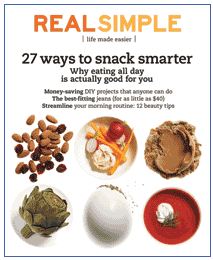
Here is an image from an advertising e-mail I got today. Sometimes I wonder about things like this.

What jumped out at me wasn't that the snacks looked good, which they don't. Or that I was drawn to the magazine cover's passive-aggressive minimalism. It was the number 27.

It's as if the editor said, We're gonna write an article about ways to snack, and when it's done we're gonna count the number of ways we wrote about it. Snaking, I mean. …Um … That will be our title. We'll put it on the cover!

And there was much rejoicing.

Why? Why does the reader care how many ways there are in the article? The title should be "Snack Smarter!" or "Tips for Smarter Snaking," or "Snack Smarter or Die." Ooo, what about, "Smarter Snacking for Better Sex"?

We see titles like his all the time.

9 Tips for defunking your hard drive
4 ways to shine shoes without getting out of bed
16 reasons not to play with fire

I can understand something like The Top 10 Ugliest Cars for 2011, or The 100 Worst US Senators. The number actually adds some meaning, or context. But I say it's time to cut back on this obsession with counting things. It's not useful information, it's it's superfluous and redundant and it uses more words without meaning anything different. Or something.

Of course, sometimes it's good to say way too much about nothing in particular. Because if you're reading a blog post like this, you're not reading the news. So I'm doing a public service.

You're welcome. 

… I got some apples today, so I'm outta here. Time for a snack.