Mr. Nava, I have a modest proposal to help close the deal on the state budget. Let’s lay off two thirds of the legislature, consolidate the legislative districts, and liquidate the real property of the state capitol, to be subdivided into affordable housing for those who’ve lost their homes to foreclosure. The remaining third of the state’s legislators can telecommute, and the capitol can reside in the servers of Google in Mountain View. Might that save some money? Please pass the idea along, respectfully, to your colleagues. … By the way, I admire your efforts on behalf of animals and strongly support your work in that area.
“The problem, dear hearts, is a common one here in the American heartland: an inability to express personal preference in simple declarative sentences, no modifiers.
E.g., ‘I vish to be alone.’
Is this a terrible thing to vish for? I think not.”
OK, I don’t want Garrison Keillor to leave me alone. I’m just playing blog post title games. We’ve never met, except through his writing and his radio shows. I listen to Writers’ Almanac almost daily on my iPod. And I’ve loved The News From Lake Wobegon for years. So I wish I could be his buddy, go hang out in his kitchen (I’ll bring good coffee) and talk about writing.
I think he knows more than I do about writing clean, clear, unencumbered prose; not belabored, for example, by words like unencumbered. Also, he speaks the truth here about solitude. We all want it, and those of us who want to create stuff crave, require, and dread it.
Knowing this is true about Keillor too, I wouldn’t overstay my welcome. Just a chat from time to time, and I’ll be off to pester JK Rowling or Steven King. And I’d repay the favor with some free proofreading, since we’re pals. I wouldn’t let the word vish get past me, instead of wish, that’s for sure.
Cowardice asks the question, ‘Is it safe?’ Expediency asks the question, ‘Is it politic?’ Vanity asks the question, ‘Is it popular?’ But, conscience asks the question, ‘Is it right?’ And there comes a time when one must take a position that is neither safe, nor politic, nor popular but one must take it because one’s conscience tells one that it is right.
I went out to do some shopping over the weekend, which is something I do absolutely as seldom as possible. I noticed, because it’s hard not to, that all the customers and cashiers were insisting that one another “have a nice day.”
I don’t get it. There is a whole lot of grumpiness and discontent out there. It’s not just that most of the people who are being asked to have one, and are implicitly agreeing to do so, are failing to have a nice day. It also seems like one would have to be having a half decent day in order to be going around admonishing others on the matter. So is civilization awash in rampant and manifest hypocrisy?
Let me be the one to buck the trend and break the spell. I’ll do the world a favor and not necessarily have a nice day; at least, not without a damn good excuse. I’ll just try to get through it in one piece and not hurt anybody else. I shall scowl if I must, but wait for the lights to turn green. I’ll hold the door a moment for those with their hands full. And if I see somebody actually having a nice day, especially if they’re not trying to get me involved, I’ll resist the temptation to kick their ass.
It’s the least I can do. And I think it was Kahlil Gibran who said something about living in such a way that others will never say you didn’t do the least you could do.
I’m reading an article on former Poet Laureate Billy Collins, from a newspaper in Norman OK:
“One of the reasons people don’t read as much poetry anymore is the fault of the poets,” he said. “It’s not the public’s fault. There’s an awful lot of bad poetry out there. I’d say about 87 percent of the poetry in America isn’t worth reading.”
It’s the other 13 percent, Collins said, that he lives for. “Poetry should be transparent. Transparent poems tend to teach themselves.”
“Or those poems should say something about the state of the poet and his environment.”
Mr. Collins is probably right, but just a little off the point. The problem is that poetry is being written at all, not just that it’s bad. The problem is that our society is superficial, shallow, impatient, and selfish. Before one can write a poem, it’s necessary to have the artistic impulse that can be expressed in no other way. Is anyone capable of thinking that deeply in the days of Twitter? It’s not fun or easy, gentle reader. Writing is hard work, and poetry takes serious stillness.
Poetry is an art form, the function of which is to reach for the ineffable, that which can’t be reached in any other way. There’s so much bad poetry only because there’s too much poetry. People are try to use art to describe thought which is simply not worthy of art. Transparent or not, speaking to the poet’s state or not, it’s garbage in garbage out.
People want to write poetry because they think they ought to want to write poetry, but they haven’t had the collision with consciousness, or the long dark night of grief, which demands to become a poem. They’ve only had the thought that wants to be a journal entry or a letter to a friend, or a blog entry. That ain’t art.
A poet is first an explorer of his own pain and joy, and an artist with language second. And poetry should be the last resort of the writer. Then if the right words are in the right order, it might be worth reading.
there are reminders of her. This place is entirely steeped in her beautiful, joyful presence. In each room, places to rest or to play. Her toys are here and there, her beloved bed, and her stroller is parked by the front door. The stillness of that alone is terrible; I will spare you more than to imagine it empty.
Here, on a much better day …
Happy used her stroller often in the past year – and daily in the last month – because she was getting on in years. And there was heart trouble, kidney disease, an ulcer. Still, she was a dog who lived to ramble, to amble, to run and run. And to ride! Oh yes.
Hard to believe those two photos were taken over a year apart, and that in the second she was already in treatment for so many things. Still smiling, still Happy.
I know, I take too many pictures with the silly phone; only 1.3 megapixels and the exposure usually sucks. Here are a bunch of better ones.
I guess those who read this blog but don’t follow the blogroll link to Happy’s Trials may not know what’s been going on. That’s our dog’s blog, where she posted her final entry Wednesday 7/8, just hours before her gentle veterinarian came to send her ahead to the Rainbow Bridge.
Happy was diagnosed with “renal insufficiency,” meaning early kidney failure, in April. She got a few fluid treatments and seemed to do better until late May. Then we thought she had a stroke, because she was staggering and stumbling. That turned out to be a thyroid imbalance and she rallied again, until an ulcer was diagnosed in early June. Then followed a course of acupuncture, herbs, etc., with a holistic veterinarian.
Throughout June, Happy had ups and downs, challenges with energy and appetite, longer naps … but there were good days, you know? Here’s a little video of Happy running through the yard and around the deck, on June 20.
We thought she was doing pretty well until this last week, around the 4th of July. The ulcer seemed to have healed, her heart was beating strong. But she got more tired, lethargic, weak. So on Tuesday she went for lab work and x-rays. I prayed that it was just a little something with her heart, because in the past we’ve been able to adjust heart meds and make her feel good. But the news was very bad. Complete kidney failure. Nothing could be done. The vet said, “you wouldn’t be wrong to let her go,” and “she’s suffering.”
Well, when you hear that, you have to do what you have to do, right? I mean the difficult and devastating thing, the brave and loving, almost impossible thing.
Now it’s Friday and she’s been gone for two days, and the house has come unstuck from earth. It seems to rise and fall, adrift on a sea of her absence. The silence, without her barking at birds or for cookies, is infinite.
This is not a tribute for my friend; I’ll post one to my Web site when the time is ripe. Because with this sorrow there is a life so much to celebrate, and gratitude for a wonderful, enduring gift. Just thought you’d want to know the strange weather, now the wind has turned.
If you have a fuzzy little friend, remember: time flees.
Ever think about your favorite hangouts? I mean those good places where, over the years, you’ve gotten a good meal, a cold beer, or a cup of joe? I was talking to a friend and fellow writer recently, about such places. And how, as we get older, good ones are getting harder to find and hold on to. Like friends, when you think about it.
Back when my friends and I were at Chico State, we had a few hangouts like that. I remember a small bar – possibly called Joe’s – with sawdust on the floor, Anchor Steam on tap, and peanuts. I used to like peanuts and cold beer. I don’t drink anymore; it’s antithetical to my quest for transpersonal and introspective clarity. Or something. It’s also expensive and fattening. But I digress.
My favorite hangout in Chico was a cool place in an old building right on the edge of campus, called the Madison Bear Garden. It was decorated – maybe slathered is a better word – with fun junk, and the food was great. Imagine my surprise when a friend’s blog post about our alma mater lead me to wonder if the joint is still there. It is, and they even have a Web site.
I’m the author of Finding Oakland, and my work appears in journals and anthologies such as Art Life, Pembroke Magazine, Cafe Solo, Rivertalk, Collage, Retooling for Renaissance, The Third Millennium, and Red Tiles, Blue Skies.
“Ryan has long had an ambivalent relationship with exposure, and she has always resisted change. ‘I’m eager for stasis,’ she says, ‘because I can count on its being disrupted.’ While some poets thrive on the drama of their own experience and others want to capture the cacophonous world, Ryan probes the cracks and edges in her mind. Out of those crevices, the disruptions in a quiet life, come her poems.”
Sure, I can understand that. It’s amazing how a deer among the trees remains invisible until it moves.
But the quoted paragraph seems to suggest that there are a limited number of sources in a poet’s life from which poetry springs. I say there are an infinite number of such sources in a single poem. Writing from the imagination is like holding the world up as a prism in which the light of creative inquiry might break, then watching the universe scatter into countless colored shafts. Thus, I have never read a poem the same way twice; not even my own.
Bloggers generally like it when people leave comments. It’s called external validation, and it’s not necessarily a good thing. Here’s a snippet of psychology textbook effluent to give you a general idea.
… self-esteem is how you regard yourself (or how you appear to regard yourself) regardless of how this view was cultivated. … Psychologists believe that a “self esteem” that depends on external validation of the self (or other people’s approval) … external validation [is] “pseudo self-esteem” … “true self-esteem” comes from internal sources, such as self-responsibility, self-sufficiency and the knowledge of one’s own competence and capability to deal with obstacles and adversity, regardless of what other people think.
Right. So here’s how you leave a comment on the blog, so I know what other people think.
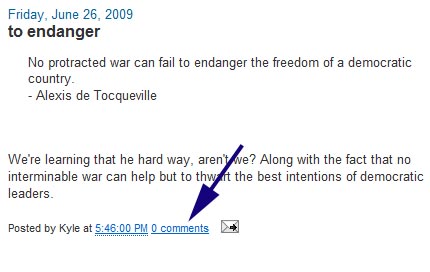
Click the link that says 0 Comments at the end of the post. If it says something besides zero, someone has already left a comment. Click it anyway. This just means we’ve all tumbled down a rabbit hole.
Type your comment in the field that appears. Be as brief or effusive as you like, I suppose.
When you’ve finished, select one of the identity options. If you don’t have an ID like those listed, just choose Name/URL. You can type in your first name only, and leave URL blank if you don’t have a Web site you want to link to.
Click Publish Your Comment.
Go have a cup of coffee, and pretend I bought it for you to show my appreciation.
Finally, look at the first image above again. See the little white envelope next to “0 Comments?” If you click that envelope, you can easily e-mail the blog post to a friend, or someone you believe is in need of punishment for some reason. It’s cool to do that.
No protracted war can fail to endanger the freedom of a democratic country. – Alexis de Tocqueville
We’re learning that he hard way, aren’t we? Along with the fact that no interminable war can help but to thwart the best intentions of democratic leaders.




 Metaphor