the summer die.
and hollow.
under this sky made of steam
with a tired smile
and his hat on the floor.
and that was always early.
of rain,
one shower at midnight.
his sad sad death.
Anyone who says it’s happening to protect artists is lying and almost certainly working for said Man.
Obviously, I’m less than articulate on the subject. But fortunately, writer Cory Doctorow isn’t.
I recommend watching his recent talk at the Melbourne Writers Festival. He has posted it on his blog.
“Any time someone puts a lock on something that belongs to you, and doesn’t give you a key, that lock is not there for your benefit.”
It be International Talk Like a Pirate Day, ye scurvy squid. And if ye think about it, blog be a very pirate-sounding word.
But truth be told, me hearties, unless I’m just bellerin’ Avast a lot, I doubt I’ll be talkin’ like a private for long. I have enough misadventures, just talkin’ like meself.
But now I’ve got the pirate song from Disneyland stuck between my ears, and it may hang on for hours.
My mind is composting tonight; not enough vegetables to harvest just yet. I meant to stop by my parents’ house today and obtain some tomatoes – there are plenty and they look very good – but I forgot. This puts me in mind of a poem:
This is the Garden
This is the garden: colours come and go,
frail azures fluttering from night’s outer wing
strong silent greens serenely lingering,
absolute lights like baths of golden snow.This is the garden: pursed lips do blow
upon cool flutes within wide glooms, and sing
(of harps celestial to the quivering string)
invisible faces hauntingly and slow.This is the garden. Time shall surely reap
and on Death’s blade lie many a flower curled,
in other lands where other songs be sung;
yet stand They here enraptured, as among
the slow deep trees perpetual of sleep
some silver-fingered fountain steals the world.— e e cummings
Isn’t that amazing? Read it aloud to yourself. Go ahead, it’s worth it, trust me. I did. Read it aloud several times.
Cummings was a master of his art. And not the least bit shy about tackling the greatest common divisors of human life. After all, that’s the poet’s job, as it is the literary writer’s in any genre. As Stegner put it:
I am concerned with gloomier matters: the condition of being flesh, susceptible to pain, infected with consciousness and the consciousness of consciousness, doomed to death and the awareness of death. My life stains the air around me. I am a tea bag left too long in the cup, and my steepings grow darker and bitterer. [All The Little Live Things]
I’m saying we should not look away, those of us who choose to take the human condition as our reason for art. Nietzsche said when you stare into the abyss, the abyss stares back at you. And somebody said you should make the abyss blink first. I think that’s a motto of Twitter or something.
Actually, Nietzsche wrote, “He who fights with monsters should be careful lest he thereby become a monster. And if thou gaze long into an abyss, the abyss will also gaze into thee.” [Link]
Truer words were never writ. And Cummings has given us something like Heaven here in two stanzas; I couldn’t imagine it written more beautifully. But for me all this begs a question:
What is the abyss in life as we see it around us? I mean here, in the other world, where the slow deep trees may sleep, but fitfully for fear of our homuncular hammers and saws.
When I stare into the abyss, I see shoes. Old, worn, creased, dusty shoes. Ironing boards, cookie jars, jars of buttons and marbles. Old phone books with the numbers of the forgotten, scrawled on the covers in black ballpoint. I see dog collars, baseball gloves, oven mitts bearing the faces of animals as symbols of hope into the ever-retreating brave new world. I see the polished to glaring hell hallways of hospitals, peanut butter sandwiches and hummingbirds hovering before a rising sun.
How about you, fellow writer? What stares back at you, refusing to blink?
*Image: Thomas Cole The Garden of Eden,1828
Writing is like driving a car at night. You can only see as far as the headlights, but you make the whole trip that way.
– writer E.L. Doctorow
Sure, Edgar, but it's worse than that, isn't it?
Writing is like driving a snowplow on a mountain road at night, in a blizzard. You can't see beyond the lights, or see the side of the road. (Yes, of course, somewhere out in the powder there's a yawning invisible precipice, meaning certain death.) Nobody can tell you where your destination is, or whether the road behind you is clear enough. But the snow keeps falling, so you keep backing up, inching forward, backing up. And at some point, you just have to call it bloody well good enough, holler let the traffic trough at their own risk, and go home to bed. Writing is rewriting, is my point. The first pass is the fun part; after that, it's work.One of my favorite writers, Kent Haruf, has shared that he writes in a small semi-basement “coal room,” in his home, where
“I have brown wrapping paper taped up on the wall, on which I make notes about whatever novel I’m working on ….”*
I can see where that would be effective. I keep a lot of notes when I’m writing too. And for a long time, I’ve struggled to find a method like that, which can work effectively for me. I’ve tried sticky notes on a big mirror, which is similar.
Most recently, when I’m writing and editing I use the comments features of the word processor. And Evernote, Google Docs, and a tangle of associated Word files. If the notes are large and not associated with a place in the existing text, then God knows. But if I’m making small notes about my existing stuff, I can insert them as comments in the manuscript itself.
Both Microsoft Word and OpenOffice.org Writer have a feature that one can use to create such comments, which appear as mark-ups. I’m sure this was designed for getting feedback from the boss, or Engineering or whatever, and I’ve used it that way at work.
In Word, comments can be viewed as balloons in the margin or as hidden boxes which appear when the cursor is moved over the relevant portion of text. In Writer, only margin balloons are used.
The comments that the writer, editor, or other collaborator have made in the text can be useful – even critical – to the completion of the work. So rather than scrolling through the document looking for the comments and reviewing and handling them, a list of comments might be made for review. Here’s how to do that.
Word 2003
Do a Print command in your usual way; whatever you do when you want to print something.
When the Print dialog appears, you’ll see an option in the lower left that says, “Print what.”
[Click images in this post to view enlarged]
Change the Print what option to “List of Markup,” as shown in this figure.
This tells the software that you want to print out mark-ups – Comments – not the whole text of the document.
Note: In that figure above, you’ll see that I’ve selected my favorite PDF printer instead of my paper printer. Unless you need your list of comments on slices of dead tree, I recommend PDF. And Mother Earth thanks you.
Proceed with printing normally.
OpenOffice.org Writer
Do a Print command. The Print dialog appears.
Click the Options… button in the lower left corner. The Printer options dialog appears.
One of the columns there says, “Comments.” You can select to print Comments only – just the comment in the manuscript – as we did in Word, above.
Proceed with printing normally.
And this is cool: Writer lets you choose to print the complete document (PDF is an option here again) with its comments gathered at the end, or at the end of each page.
Hope this comes in handy. It does for me.
* Kent Haruf’s column on the habits and methods of writing, To See Your Story Clearly, Start by Pulling the Wool Over Your Own Eyes, was published in the NY Times, 11.20.2000.
No matter how piercing and appalling his insights, the desolation creeping over his outer world, the lurid lights and shadows of his inner world, the writer must live with hope, work in faith.
On a good day, I have enough challenge just trying to ignore the thumping of passing cars and the porcine squeals of the neighbors’ sugar-hyped and excitable progeny. I go for weeks without glimpsing my inner world, and then it’s only late at night. Which throws the desolation creeping over my outer world into stark and unnecessarily tactile relief.
It’s probably just as well that – at least so far as the quote is concerned – Mr. Priestly didn’t trouble himself to be specific about the objects of his hope and faith.
So here’s to the opportunity to conjure and ensconce our own.
And here’s something very cool to read: an essay on the totems and rituals of writing, by Kent Haruf, from the NY Times.
I commend to you today’s Writer’s Almanac, which contains birthday notes on Booker Prize winner Kiran Desai, the youngest woman to win the Booker Prize.
She wrote and wrote and wrote, and one point had 1,500 pages of notes for her novel. … she hadn’t expected it to take eight years of her life to write the book … She was impoverished and filled with self-doubt … That second novel took her eight years of full-time writing, and it turned out to be a masterpiece, a complicated, multigenerational tale that explored all sorts of important contemporary issues, told as a brilliantly compelling story. And that novel, The Inheritance of Loss, published in 2006, won the Booker Prize.
Anybody out there writing full time? Well, that’s how you win the big prizes, kids. Keep the ass in the chair. I could have written five novels by now, with that simple method. Still, I like stick-to-it success stories. Sometimes. Other times, they just piss me off. They call on me to generate too much sympathy for irrelevance, or too much personal humility.
"Writing, for me, means humility. It’s a process that involves fear and doubt, especially if you’re writing honestly."
— Kiran Desai.
He was just humming through his day like one of those little robotic vacuum cleaners, and probably thinking about pickled things that really shouldn’t be, and bothering nobody, when this suddenly dawned on him:
The major difference between a thing that might go wrong and a thing that cannot possibly go wrong is that when a thing that cannot possibly go wrong goes wrong it usually turns out to be impossible to get at or repair.*
Then the humming resumed.
* Douglas Adams
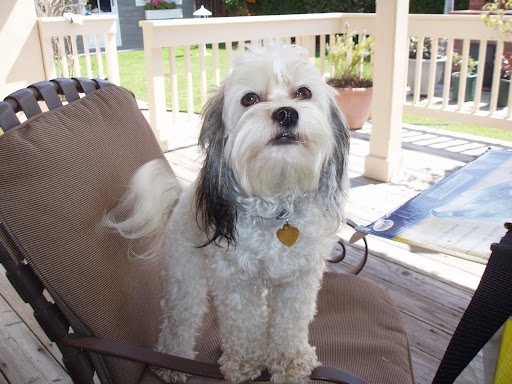
Etta is a wonderful little Cavapoo, who loves to run and play. She gives kisses, wrestles with her toys, and does a twirly dance for her dinner. She’s not my dog, but she’s a personal friend of mine.
I’ve posted photos of Etta on a couple of sites, and will add more – plus videos – when time permits.
Click here for a Goolge photo album.