Writer Billie Hinton has posted a beautiful meditation on how love transcends loss, and the powers of memory and family.
She sees, they are all spiritual moments.
Billie’s books can be found on Amazon.
Writer Billie Hinton has posted a beautiful meditation on how love transcends loss, and the powers of memory and family.
She sees, they are all spiritual moments.
Billie’s books can be found on Amazon.
I have a table in my home that is not supposed to be cluttered. It’s a rule I have for myself, which I only occasionally break: Don’t put stuff on the dining table. Books and magazines belong elsewhere. Snail mail (can you even believe it still exists in 2013?) goes in a basket in the home office. Despite the rule, I recently found myself needing to clear off that table. The only way to do that is to remove things. Moving them around on the table does not help.
That table is a lot like Mind. Well, it’s hard for anything not to be a metaphor of Mind, but take my word for it. It’s impossible to solve problems with a cluttered mind. And you can’t solve problems with the same state of mind that created them.
David Allen, the author of Getting Things Done, says that the main issue of a stressed out, non-productive life is the lack of bandwidth (table space) “… to be able to engage appropriately. Worse is that our creative energy is being used to fix and handle, remember and remind. We use our psyche to do this, instead of a system.”
Allen says, “Don’t use your mind to accumulate stuff and avoid it. Don’t use your mind to get stuff off your mind.” And, “Don’t keep anything in your head for the rest of your life.”
If I understand, he doesn’t mean don’t let certain things stay in your head that long. He means for the rest of your life, don’t use your mind for storage. It has better work to do. He says that our thinking has to be captured so that it can get out of the way of our problem solving or creative efforts.
“Capture your thinking. Get it out of your head. Anything and everything that is potentially meaningful – big or little – write it down.”
It seems I am constantly encountering people who are stressed out by problems but have no system for dealing with them. They have a mess to clean up but no space to work on the mess. Their mind is full of everything they need to keep remembering and there’s no bandwidth left for problem solving.
The worst part is when they blame the table for the mess that’s on it. They blame technology. Their computer or their phone, that’s the problem. Modern life is too complicated. It was better when it was simpler. The forget that any system, whether it employs sticky notes or Evernote, requires some planning, practice, and maintenance.
Well I remember the days before computers, when the phone hung on the wall and had a dial. The people who could solve problems were the ones who knew where their tools were: shovels and wrenches, glue and scissors, and the first aid kit. A place for everything and everything in its place. And if you needed to learn something, it helped to know the Dewey Decimal System and how to use the index cards in the library. There was a system, and it was not accessed by memory or luck. It was not kept inside of anyone’s head.
Ray Kurzweil is a prominent futurist, author, and a lead engineer at Google. He predicted the Internet, search engines, speech recognition, etc. He says that humans are becoming non-biological, that we are merging with our technology, and that our smartphones are extensions of our brains. So be it. Our forefathers had their parchments and notebooks. Da Vinci and Jefferson didn’t try to keep their projects in-between their ears.
We have better tools now. Whether what works for you is a desktop computer, a mobile device, a Moleskine and a pen, or some variety of tools, we all need a system to keep life from overwhelming us. Even the humblest of intellects needs to prioritize their thinking to keep from overloading, stressing out, and teaching a colleague how to roshambo.
Since the invention of written language, Humankind has kept the bulk of its knowledge, wisdom, poetry, history, calendars, etc., in systems outside the damp confines of the brains of humans. They wrote stuff down. The difference now? We can carry it all – the entirety of amassed human information – around in our pockets. And Twitter too.
Right now, I’m thinking about these words and their best order. My Google Calendar knows when my doctor’s appointment is next week. I don’t. My technology will get me there, and remind me to pay my insurance bill and water the ficus in the living room, and what I’m supposed to pick up at the store. I’m not trying to remember it, is my point.
I hope you have a system that works well for you.
The next time someone asks me why I always have my phone, I’ll tell them it’s for thinking. I’m not playing bloody Angry Birds or laughing at grumpy cats. I’m thinking. Just like a notepad and a pen, this machine does mental work and is an extension of my consciousness. And someday, when I’m gone, you can download my consciousness into a Roomba, and I’ll quote T.S. Eliot while I vacuum the rugs.
We have lingered in the chambers of the sea
By sea-girls wreathed with seaweed red and brown
Till human voices wake us, and we drown.
Free Software Because Free Stuff is Cool
A short post on free LibreOffice software, and the free and cheap software I like to use for writing.
“What time is it?”
Taking one hand from the wheel, he started to push back the sleeve of his jacket to see his watch, then stopped. He glanced over at her. She sat looking out her window through the rain, at the trees.
“There’s a clock on the dashboard in front of you.”
“Is it right?”
“Yeah.”
“So you won’t tell me?”
“What’s the use of having a clock in the car, if you always ask me anyway?” But now he did push back his sleeve and look. “The clock on the dash says the world is one minute older than the watch on my wrist. So I’m going with the clock. I’m feeling pretty old right now.”
She frowned and watched the trees, a dark wall and a dark road, a grim and rainy day. She did not look at him, or care about the time. It was only something to say, some excuse to conjure his voice out of the distance between them. It was a good voice, solid and deep, a comfort so often, and always in the dead of night. Sometimes she lay awake and whispered I love you, and he would answer in that voice, without waking. Love you too.
As they passed the end of the orchard, a field opened up. It was fallow, the earth broken and turned. Far back from the road was a brick house and a barn. The house was brightly lit, and smoke rose from the chimney. It was a stranger’s life sitting quietly surrounded by death, waiting to be swallowed by time and rain. She could not wait to get home, turn on lights and music, make tea, and pretend, like that house pretended, that the world was safe.
“I hate myself for leaving him there.”
He checked the mirror and said, “It’s a nice place.”
She turned at looked at him. “Nice? I hate us both.”
“Now, now. Yes, it’s a decent place, as …”
“And he hates us too.”
“… as such places go. Pleasant and homey.”
“Well.”
“He’ll come around. It’s very nice. He’ll get used to it, make friends, have activities. You saw they have a piano in the recreation room. And the courtyard will be warm on sunny days. We’ll visit and take him outside. He’ll be fine in no time.”
“He’s never yelled at us like that. Never at anyone, that I can remember. So angry. Like we’re Eskimos, shoving him out on an ice flow.”
“We’ve been over this. Can you really pretend we’ve been thoughtless?”
“Do they even do that, did they ever?”
“What?”
“The Eskimos.”
“I don’t know.”
“He said we’re going to hell.”
“Oh God. Everyone is on their way someplace, but not there. And we’re only doing our best.”
“No. We could do better. We should bring him back. Fix up the spare bedroom.”
“Honey.”
“Rent one of those hospital beds. I could take care of him, I know it. I could quit my job, we’d get by.”
“You couldn’t. You can’t even lift him. Neither can I.”
They passed the end of a narrow road that broke the blur of idle land and disappeared toward the hills. She saw that her hands were resting on her lap palms up, waiting to be filled by something only God could design.
“You know him better than me.”
“Yes,” he said.
“Since the hour of your birth.”
“Jesus.”
“So I hope you’re right. But he’s already haunting me.”
There was another line of trees close against the road. Almonds, dark and full of rain.
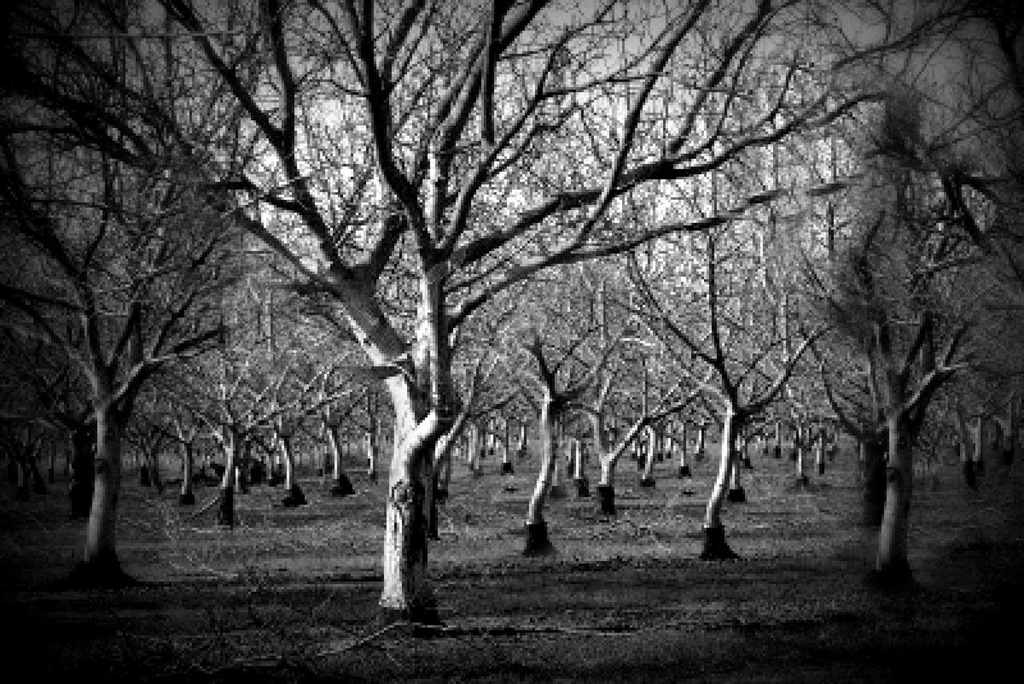

Passing Trees by Kyle Kimberlin
is licensed under a Creative Commons Attribution
-NonCommercial-NoDerivs 3.0 Unported License.
A new poem to share.
I have a movie to recommend, and a beautiful song to share.
“Where’s the “just be” in there? Where’s the time carved out for me and removing the pollution in the mind?”
A group of around 85 bloggers on Google+ – including me – will be blogging there during the month of August. Here’s a link to the circle.
Here come the Blogs of August!
I will be posting links here on Metaphor to everything I share. So Metaphor will look different, but its followers won’t miss anything. In fact, there will probably be a lot more links to stuff here.
I like Google+ and I enjoy the diversity and engagement there, but I have a community here on WordPress that is also important to me. That means you. So I have no plans to kill this blog. But learning means trying things.
Tonight we have a guest poet on Metaphor. It’s our dog, Brookie. I asked her to share a poem in honor or her one year anniversary with our family. She was adopted July 23, 2012. She’ll be two years old in October.
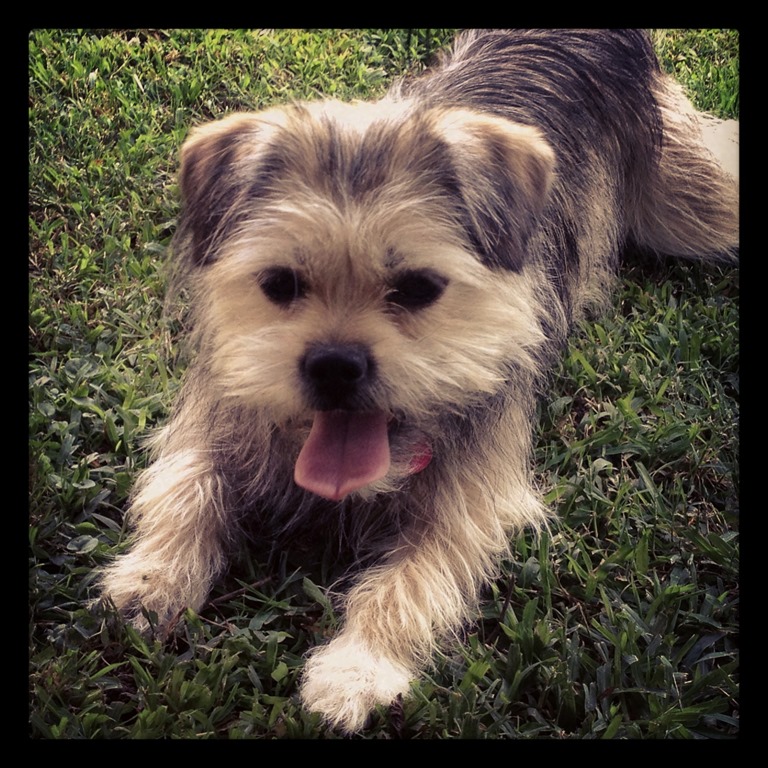
I bark because of the birds
in the grass and above on the wires
and how they dance away
or fly and disappear
when I want to be close
I bark because of the people
and the dogs I can smell
going by on the street
and how they keep moving past
always do not stop and play
So I bark being so often
acquainted with disappointment
but also because of the sunshine
and my good food and my toys
and how much I feel all this joy
by Brookie
Brookie composes with a #2 pencil on a yellow legal pad. She blogs at http://brookiestrials.blogspot.com/
and she’s on Tumblr at
http://brookiestrials.tumblr.com/.
I’ve suggested she cut the cord with Blogger and go with Tumblr full time. It’s really more her style. I guess she’s thinking about it.
The names of her blog and tumblr site were inspired by the title of a book, Nop’s Trials by Donald McCaig, and by the lyrics of the old hymn What A Friend We Have in Jesus. The term trials, in dog circles, refers to competitions for herding dogs, obedience competitions, and similar events. Obviously, it’s a metaphor.
Have we trials and temptations?
Is there trouble anywhere?
We should never be discouraged,
Take it to the Lord in prayer.

Joyful Noise by Kyle Kimberlin is licensed
under a Creative Commons Attribution-
NonCommercial-NoDerivs 3.0 Unported License.
Today was my grandfather’s birthday. We called him Papa though, and he’s in heaven now. And this isn’t about him – or me – but in honor of … inspired by …
The sun rises slowly so that everything – the light, the birdsong, the smell of cooking food – is a long and tender hug. The musicians sleep until noon then sit about the plaza singing dirges as the day gets hot. He remembers his Papa would send him to the kitchen for a “glass of good cold water” on every summer day like this. Then he would take out his pocket knife, with a warning for it’s sharp little blade, and send the boy out to pick tomatoes for lunch in the amazing heat. He grew up with memories of water and fruit, but he still arrived at here and now, and there is no remedy for that.
It has been a summer of strange dust and barking dogs, and the music in the streets is flat. The players strum and knock their guitars with heavy silver rings to keep the beat. They sound like horses walking on stones in the shade. The trees drink all night from somewhere deep beneath the town, and put on clusters of yellow blooms. Any breeze will blow the flowers down around the fountain, to be swept away.
He works all morning, eats too much at noon and by evening he knows that he will never leave this place in all his life. He has an orange tree, clean shirts and a place to sleep in a room in a house that’s a cluster of rooms the use of which he has forgotten long ago. Except the ones for eating, bathing and sleep. All such things he does alone, and cuts many flowers for the dead. He has the music as the day goes by.
His room is hollow, a hollow room in a hollow house. Like living in a musical instrument, a sounding box for playing the noise from the freeway and the breath of the night wind. He sits in it after the sudden slow day, drinking cold water, letting the night play every song it knows. Everything vibrates, trucks brake for merging traffic, and the sun comes up softly again in the dust.
Life has few expectations, makes no demands, in a town this size. Just the little things, kind words and a gentle touch. So he made her breakfast the way she liked it, waited a moment and went out. Every day the same, and the summer ended and the oranges got ripe. The days got long again and he couldn’t keep her anymore. He offered her food and water with ice. He tried holding tight and letting go. Couldn’t think of a prayer except no and no. Which has never stopped the angels from their work.
He wakes up late and finds the blanket kicked to a heap beside the bed. The sun on the shutters is already hot and the horses in the plaza drink from the fountain, stamp on the stones. Or the players knock their rings in the singing air. He sits naked on the bed and wishes it was night again and not so far from here to where she went. Not so much bright and hazy world to search. Maybe he’ll try the closet where she kept her pretty things, or part the air by the trees like a curtain in the heat.
He could slice oranges and lemons with his Papa’s knife, leave them for the birds, for an offering of his solitude. Bittersweet. And a glass of good cold water.
A Glass of Cold Water by Kyle Kimberlin
is licensed under a Creative Commons Attribution
-NonCommercial-NoDerivs 3.0 Unported License.
 Metaphor