The Doldrums

It’s quiet in here, too quiet. I haven’t heard the music of words lining up and thumpimg together for quite some time now. Writing makes me happy and I’m not writing. But I don’t get writer’s block. I don’t believe in writer’s block. I believe in the horse latitudes. If I don’t keep the little boat of my consciousness out in the trade-winds, in the shipping lanes of language, I wind up windless and adrift. Becalmed.

I know what I have to do. Just as horses were sacrificed on sailing ships becalmed on their voyage to the New World, thrown overboard to save water for the men and lighten the ship, I need to make a change.

No one needs to have their forelegs cracked and be tendered to the vast, insensate Deep. I just need to find some time in my day for reading. Those who are artists understand; no planting, no harvest. No peace, no art.

Let Them Alone


If God has been good enough to give you a poet
Then listen to him. But for God’s sake let him alone
until he is dead: no prizes, no ceremony,
They kill a man. A poet is one who listens
To the nature of his own heart; and if the noise of the
world grows up around him, and if he is tough enough,
He can shake off his enemies but not his friends.
That is what withered Wordsworth and muffled Tennyson,
and would have killed Keats; that is what makes
Hemingway play the fool and Faulkner forget his art.


– Robinson Jeffers

To Know and Not to Know

Yea, though I walk through the valley
of the shadow of death, I will fear no evil….

Here’s a writing idea for us, for a bit of horror fiction. I don’t really write horror, but I’ve come close, so I’m willing to give it a shot.

Imagine a dystopian society — perhaps post-apocalyptic, Orwellian — in which each week the people permit an armed person to enter a school at random and attempt to kill one or more students. The killer might be an adult or another student. It’s random. It goes on week after week. Children die, so it goes.

The police would do anything of course, but they’re always a moment too late. No champion arrives to protect the children because no one knows where the next shooting will occur. The leadership of the land is helpless, in part because this suffering is accepted as the sacrifice for freedom. And if they try to stand and speak they’re shouted down, rebuked, reviled, and lambasted for their liberal proclivities.

Imagine there is a slowly rising tide of grief, rolling like muddy water in a shallow ditch of tragedies recalled. The people grow tense and tired, though they’re becoming immune to pitiful images of candles and flowers and teddy bears stacked against walls and curbs and chain link fence.

How long should we — the authors — let the present tense arc of bloodshed go on, before that salty wave of past tense sorrow overcomes and washes it all into a poignant denouement?

Do you think we could write such a tale with verisimilitude? I don’t know. It’s hard to imagine a society that wouldn’t put the safety of children above all other motivations, or a country where this could really happen every f—king week, for months on end.

Maybe instead of a treatment in short story or novel, we could pitch it as a movie of the bloody week.

The attack with what police said was a semi-automatic weapon — “Shooter dressed in all black w AR-15 and vest and helmet. Cornered in bathroom by officers” … was the 74th since December 2012, when Adam Lanza killed 20 children and six adults at Sandy Hook Elementary School in Newtown, Connecticut. That’s one about every eight days.

In 2014 so far, there have been 37 school shootings. As of February, about half of the incidents were fatal.

http://nymag.com/daily/intelligencer/2014/06/oregon-school-shooting-74th-since-newtown.html

————————————————————————————————————-

To know and not to know, to be conscious of complete truthfulness while telling carefully constructed lies, to hold simultaneously two opinions which cancelled out, knowing them to be contradictory and believing in both of them, to use logic against logic, to repudiate morality while laying claim to it, to believe that democracy was impossible and that the Party was the guardian of democracy, to forget, whatever it was necessary to forget, then to draw it back into memory again at the moment when it was needed, and then promptly to forget it again ….

— Orwell, 1984
Half Past Eternity

“Let us be grateful to the people who make us happy;
they are the charming gardeners who make our souls blossom.”
― Marcel Proust

I tell you I am aging relentlessly, thrown
open to the ocean air like a sash window
framed by peeling paint. That’s how it is.
But I have been held close, held up
into sunlight and moon wind, into branches
of old trees, held so tenderly and helped
to lean out over water rushing into death.

You and I are still alive. Don’t be afraid.

You know that life is hiding from us, though
we caught a glimpse this morning, where
it fell as a shaft of light across the floor.
It rose and flew like a moth down the long
hall and disappeared. As a child I saw
life fly in through the window while
morning arrived and my grandmother
was singing in another room. It fluttered
by and rested for a while on my hand. 

The house is gone but not that room, not yet.

papa_tomatoes_1989_crop1

This candle’s tiny flame is all we know of fire,
no less than a sun, and all of time
is moving in this single clock. I wind it
twice a week and see behind the glass the marks
where Papa’s fingers brushed its face.
We do not die, his garden goes on forever.
So we can see him planting tomatoes
in a day of late spring resurrected,
swaying in green and yellow light.
A breeze parts Grandma’s linens drying on the line.

That day will live as long as we need it to.

From a distance he appears soft and kind
and now he is visible only at the focal length
of years. Seated on the sofa in an umber light
he sets his watch. Half past eternity. He looks
up at us as if to speak, but so much silence falls
between.  Did he remember, as the evening
softened and grew dim, the cry of the dogs
through the tangled woods?

They always knew the dark road home.


Creative Commons License
Half Past Eternity by J. Kyle Kimberlin is licensed
under a Creative Commons Attribution-
NonCommercial-NoDerivatives 4.0 International License
.

Watermelon Memory

Watermelons are in the stores again. I saw some today, large rafts of watermelons looking confidently variegated. They know they’re all about the mystery. Schroedinger’s fruit, both sweet and not, ripe and not, until opened. I could smell peaches too but I was after other things — yogurt, bread, soup — so the watermelons and peaches had to wait.

So what’s the point? Just that I like the word watermelon. Also rainbow, piano, and river. Peace is a good word, but arguably subjective, inconclusive. Watermelon is a faithful, unambiguous, and explicit word. It means what it is and it sits in the mouth just long enough to make its point.

Watermelon is a memory word for me, like fireworks or campout, thought not laden as Christmas. When I remember watermelon, I think of a poem I read in the 1970s, called Reflections on a Gift of Watermelon Pickle. Which I’ve never had, I think; only fresh for me, thanks.

During that summer–
Which may never have been at all;
But which has become more real
Than the one that was–
Watermelons ruled.

And here’s my take on the topic of watermelon memory, a repost from a few years back. I like this poem. The person addressed is not my child, by the way; I have none. This is a personal poem, nonetheless.


Watermelon

Child, if you care to remember
this world, this life
you dream like a path
of certain distance quickly
walked and centered on a hill,
if you care to open it like
watermelon in summer
or like a prayer box
bearing a constellation of crosses
and sunsets, I hope
you consider your father,
his overtures to death,
his music, and like sunlight
through the sprinkler
on a simple greening lawn,
his smile.


This post from a few years ago seems complimentary.
Creative Commons License
Watermelon by Kyle Kimberlin is licensed under a Creative Commons Attribution-NonCommercial-NoDerivatives 4.0 International License.

Link

Nathaniel Mackey wins Lilly Poetry Prize

“The poetry of Nathaniel Mackey continues an American bardic line that unfolds from Whitman’s ‘Leaves of Grass’ to H.D.’s ‘Trilogy’ to Olson’s ‘Maximus’ poems, winds through the whole of Robert Duncan’s work and extends beyond all of these. In his poems, but also in his genre-defying serial novel (which has no beginning or end) and in his multifaceted critical writing, Mackey’s words always go where music goes: a brilliant and major accomplishment.”

Don Share
Poetry

Last Words

Do you ever think of the art of leaving the world with a good one-liner? It is an art form, you know, though perhaps generally inadvertent. For instance, James Brown said, “I’m going away tonight.” Lewis Carroll said, “Take away those pillows, I shall need them no more.” Lou Costello said, “That was the best ice cream soda I ever tasted.” And Thoreau said, “Moose … Indian.”

Don’t misunderstand: I’m not expecting to need a good one any time soon. I was just thinking about it, and thought I’d have a bit of fun. so I’ve been making a list of little phrases that might serve on on the way out. Most are original, while some are based on the profundity of great thinkers from Oscar Wilde to Charlie Brown.

Let me know what you think. … Oh, and here’s a poem too.

  • I hid the gold behind the …
  • Well, I sure didn’t see this coming.
  • Aw, who cut the cheese?
  • Keep your hands and feet inside the ride at all times.
  • And now for a word from our sponsor.
  • Excuse me a moment.
  • Somebody wind the clock.
  • I smell pancakes.
  • Time to piss on the fire and call the dogs.
  • Good grief.
  • Don’t tell me, let me guess. 
  • Is there any more pie?
  • Stand back, let me handle this.
  • Either this wallpaper goes, or I do.
  • Now was all that really necessary?
  • I make a motion to adjourn.
  • Has anybody seen my hat?
  • Well, that’s how they get ya.
  • Tomorrow will be beautiful.
  • Get the gate.
  • Did you say wheat?
  • Stop at the next gas station, I need to pee.
    And finally …
  • Don’t laugh, you’re next.

The Last Word

So this is what it’s like
to be alive.  It is all
so difficult; the air and light
resist me.  Even the music
makes me cry or laugh.
I expected we would have wings
and make love behind waterfalls.
I thought there would be
more owls
and elephants fearlessly singing.
I thought I could make you believe
in water running through rocks
between the trees.
You would bend down to drink
and find me living there
with the last word of the first poem
that would ever make you weep.
Then you would love me.  Then
you would return my calls.
But here we are, living
on our oily streets
and the malignant traffic running
between us, helicopters
pounding down the sky.
The elephants are wise
and careful and very shy.
So I am leaving messages
for you:  the last word
of every poem I write.


Creative Commons License
The Last Word by Kyle Kimberlin is licensed
under a Creative Commons Attribution-
NonCommercial-NoDerivatives 4.0 International License
.

Tiny Kites

These are my words.

You can see how each lines up

behind another and they wait

like tiny kites to be lifted by the wind.

But they can’t fly. I think

it’s possible they are nervous,

shocked by the fall to earth.

So they lie among shreds

of paperbark in the long grass,

strangely happy, just glad

to see that you are near.


Creative Commons License
Tiny Kites by Kyle Kimberlin is licensed
under a 
Creative Commons Attribution-
NonCommercial-NoDerivatives 4.0 International License
.

Bill Richardson

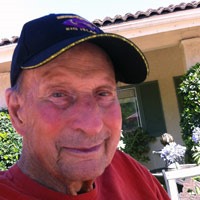
Bill-Richardson-2013I was very sorry to learn of the passing of writer Bill Richardson of Santa Barbara.  I met Bill several years ago in a Montecito coffeehouse and had some opportunities to talk with him. I never took one of his classes but I knew he was a writer, teacher, and a veteran of military service. He mentioned other things he loved to do in his life, such as dancing and hunting. As his obituary in The Independent explains, he was a renaissance man, who lived by his own lights.

Bill was kind, thoughtful, and attentive. He told me about serving in WWII and living high up on Mountain Drive. I remember when he mentioned the loss of his home to fire in 2008. His words were stoic, accepting of life on life’s terms, but there was unambiguous sorrow in his eyes.

Bill always had notebooks with him; he was writing toward sundown. May all we writers have such insight. And when he asked about my writing and what I was working on, he listened. He was ready with a word of encouragement, so I knew I had met a good teacher.

Godspeed.