Lost in Thought

I just finished rewriting this poem.


A Shade Of Old Wine

I am at home now,
safe above the town.
But wasn’t I lost?

I believe I went somewhere
and returned carrying something.
I ache. I’m tired from walking
and bearing the weight of it.

The mind is vast and powerful,
an empire of its own design.
It has a harbor full of ships
and armies raised for war.

We send messages out
through the darkness that drips
from trees around the house.

Did you see me pass by
yesterday or any time
this afternoon?

I was wearing this shirt,
a shade of old wine
with blue stripes.

I might have looked
this full of sin, this lost.
I’m sure I was walking alone,
carrying something.

Creative Commons License
A Shade Of Old Wine by Kyle Kimberlin is licensed
under a Creative Commons Attribution-
NonCommercial-NoDerivs 3.0 Unported License
.

Notes:

How large is consciousness? If, as Charles Simic says, there may be a moon shining within a stone, and just enough light to make out the star charts on its inner walls, then the limits of consciousness – if there are any – surely have no relation to the size of the human skull. Or the body’s place on planet Earth.

In order to imagine a walnut must consciousness be that small? It it can conceive the universe, isn’t it at least that big? Regardless, the mind is an easy place to get lost.

Here’s Simic, reading his poem Stone.


Intangible Things

I was clearing a few things out of a desk drawer and found a yellow sticky note with this phrase written on it:

“Intangible things are the writer’s business.”

I Googled it but I can’t find the source of this quote. It used to be the tagline of this blog, Metaphor, and now Google only points back here. (I switched to the quotation from Keats, above, in April 2010.)

I don’t think I made it up. It’s too brilliantly succinct to be me. I believe it though. We are surrounded by a cloud of the unknowable, unnamable, unspeakable and formless. The artist’s job is to give its particulars form and name, color and voice. The rare willingness and arguable ability to do so is the reason why we creative types get the big money.

Probably the first intangible, nebulous thing that comes to mind is my identity. I don’t mean the identity that a hacker can steal and use to buy stuff. I mean my self image. Who am I? Am I a good man or a self-centered jerk? Can questions of identity be that simple?

I remember studying the pathos of self image in college psych classes. I hope it’s not too wrong to say that your self image is who you believe you are, right or wrong. It’s what gets offended and bruised when someone misjudges you. And if you suddenly discover that the image of yourself that you’ve believed for a long time has been wrong, well that shit is really going to hurt.

Vanitas vanitatum et omnia vanitas.

If my sense of myself is intangible, isn’t my sense of belonging, of community, even more so? Can we expect our images of self to fit together like Legos? And then how is it even possible to dream, to have dreams, if we know so little about who we are?

“If you want a certain thing, you must first be a certain person. Once you are that certain person, obtaining that certain thing will no longer be a concern of yours.”
~ Zen proverb

I don’t know who I am, except that I go through most days with a vague sense of disappointment and a wariness against pride. I am, as Douglas Adams said of planet Earth, “Mostly Harmless.” I place a high value on Albert Schweitzer’s “Gentle hands and kindly words,” and love the first sentence of the anonymous 19th century Russian book The Way of a Pilgrim:

I am by the Grace of God a Christian man, by my acts a great sinner. 

I can tell you more about my fears than about my dreams and desires. I know what and whom I love, that I have loved and been loved, that I am loved for today. But I’m not sure what I want, except that I’m sure I will always want love in my life. No one wants to be lonely.

At this point, you might want to listen to James Taylor sing Don’t Let Me Be Lonely Tonight, just because, you know, I rock at blogging. Smile  


If I don’t know myself, I certainly don’t know you. I’m still struggling to understand Kyle and everyone I’ve ever known. William Stafford said it best:

If you don’t know the kind of person I am
and I don’t know the kind of person you are
a pattern that others made may prevail in the world
and following the wrong god home we may miss our star.

Do you know for sure who you are? Is that a question you like to explore? I imagine you do. Such intangible things are common among us, being tribal creatures. Perhaps the world’s remaining elephants would nod in agreement and commiserate.

I’ve quoted this passage from Stegner’s “All the Little Live Things” before.

“I am concerned with gloomier matters: the condition of being flesh, susceptible to pain, infected with consciousness and the consciousness of consciousness, doomed to death and the awareness of death. My life stains the air around me. I am a tea bag left too long in the cup, and my steepings grow darker and bitterer.”

The writer’s job, then, is to walk the common thoroughfare, observe the suffering therein, and take a few notes; to reach out now and then and touch the hand of a fellow pilgrim on the way to infinity. Not a bad gig, right?

The problem, fellow pilgrim, is the fog, isn’t it? The blinding, low-down tule fog of the mind. It obscures everything: the road ahead and behind, the ditches by the side of the road, the trees and hills, the reason why your character can’t sleep, never finished building his boat, or became a long haul trucker.

I don’t know about you, but I write to find my way through that fog. This effort to see, to understand, to try to share the shapes forming in the thickly settled gray, is the path of all poetry. Poets are explorers of the intangible.

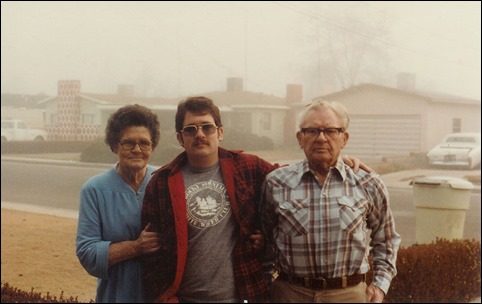
I remember one early morning in 1985, coming down the Sacramento Valley at Christmas. The fog was so thick, I had to open my door and look down beside me to see the line painted on the road. I survived.

Here’s a photo of me with my grandparents, taken in 1983. The fog in the background was lifting and I was eager to get on the road, back to college, and on with my exciting and promising life. I just had no idea how long the fog would stay on the ground.
foggy1983

Suit Up

“Keep on writing, no matter what! That’s the most important thing. As long as you have a job on hand that absorbs all your mental energy, you haven’t much worry to spare over other things. It serves as a suit of armor.”

– Eugene O’Neill

What is Essential

Last night I was reading All The Little Live Things by Wallace Stegner. It’s an amazing novel, literate and deep.

So I was clicking my Kindle along contentedly, having a cup of tea, when I came upon this passage:

“I was beginning to comprehend it then, and I have not repudiated it now: that love, not sin, costs us Eden. Love is the carrier of death — the only thing, in fact, that makes death significant. Otherwise it is … a simple interchange of protein.”

Oh dear, I thought, a hit. A palpable hit. It’s going to cause a poem. What I wrote is not really on point, more tangential. But I wonder, if love gives death its meaning, then what gives love meaning? Isn’t it the soul alive, aware of itself with respect to life? And isn’t the soul on a restless journey? And where is it trying to go? 

To My Soul

I say to my soul child hush,
you have caused enough pain.
Be still and watch the birds.
See how they disappear
at sundown, looking for home.
Or maybe they carry it with them
in ways that we cannot even,
being human, comprehend.

Be still and know that God Is
so we are not, and if trees
can stand for a thousand years,
you can sit for a moment,
drinking water in the shade.

My soul will only misbelieve
and long for the rhythm of oceans,
how the storm comes bringing
the destruction of change.
Still, quietly, I sit here
and wait for forgiveness.

Kyle Kimberlin
October 2013

Tonight I found this quote on a friend’s poetry blog. I read it years ago and had forgotten it, but remembered somehow. I would have guessed the idea of “I say to my soul …” was from Rumi, or maybe Antonio Machado. Maybe so, but here it is in Eliot. The subconscious learns.

“I said to my soul, be still and wait without hope, for hope would be hope for the wrong thing; wait without love, for love would be love of the wrong thing; there is yet faith, but the faith and the love are all in the waiting. Wait without thought, for you are not ready for thought: So the darkness shall be the light, and the stillness the dancing.”

— T.S. Eliot

Creative Commons License
To My Soul by Kyle Kimberlin is licensed
under a Creative Commons Attribution-
NonCommercial-NoDerivs 3.0 Unported License
.

Advice

If you have any young friends who aspire to become writers, the second greatest favor you can do them is to present them with copies of The Elements of Style. The first greatest, of course, is to shoot them now, while they’re happy.

– Dorothy Parker

While My Fountain Pen Gently Weeps

Oh dear. Oh good grief. I seem to have made a mistake, a very long time ago. 

I just discovered it because I was closing the windows and noticed how much cooler it is this evening than it was a few nights ago. Which made me think of the grand parties my family used to have on the equinox, with the mulled wine and cider. Yes, and the traditional blue pickles and the clowns, knife throwers, and the trained acrobatic newts.

No really, we had parties like that, as far as you know. Which reminded me of a poem that I wrote and which was published back in 1992. I had to search the archive because I couldn’t remember the title correctly. You’ll see why, I think. 

SOLSTICE

I thought I heard
the summer die.
It was a small sound
and hollow.

He sat here with me
under this sky made of steam
with a tired smile
and his hat on the floor.

We only said good morning
and that was always early.
But there was one day
of rain,
one shower at midnight.

I hope he will forgive me
his sad sad death.

Indeed it is to laugh. Keeping in mind, this puppy was published. In a book, by a publisher. Copies were sold and (mostly) given to people. It was perched like a dead parrot on Barnes & Noble’s site for about 10 years. I think maybe it went out in a couple of journals too. With a title that’s just simply … wrong.

It should have been called Equinox, right? That’s the end of the summer; there’s not a solstice for 3 months in either direction.

What are you gonna do? Sweep it under the rug I guess. So hey, don’t tell anybody.


Solstice is from the book Finding Oakland
© 1992 by Kyle Kimberlin
Published by White Plume Press, Seattle.

Thanks For Subscribing

I made a mental note, I think, to post some acknowledgment when Metaphor’s subscriptions reached 1000. But that’s the thing about mental notes, you know? The meat is doing the thinking.

crowd_01

There were 800 of you subscribed to Metaphor on August 1. Now on September 20, there are 1,115. That’s awesome. The blog has been active on WordPress for about a year and a half. My old address on Blogspot was active for about a decade and had 5 subscribers.

Thank you all for subscribing. And thanks for commenting, liking, and sharing my posts.

You are appreciated and I hope you have a peaceful day.