Throw Me A Line

Somebody throw me a line, I say!

What we call the beginning is often the end
And to make an end is to make a beginning.
The end is where we start from. And every phrase
And sentence that is right …
Every phrase and every sentence is an end and a beginning,
Every poem an epitaph. And any action
Is a step to the block, to the fire, down the sea’s throat
Or to an illegible stone: and that is where we start.
We die with the dying:
See, they depart, and we go with them.
We are born with the dead:
See, they return, and bring us with them.

No, no, not lines from T.S. Eliot. I mean like a rope, a ring, a by god floatie or something. I am drifting too far from the shore, and will soon find myself in The Horse Latitudes again.

Words move, music moves
Only in time; but that which is only living
Can only die. …

the end precedes the beginning,
And the end and the beginning were always there
Before the beginning and after the end.
And all is always now.

Now stop that! I’m saying it’s hard to keep focus in these long warm days. Summer is the season of doldrums and earnest urge to nap. I’ve not succumbed, but how long has it been since my last blog post? And since engagement brought me up and out from between the lost and arid pages screens? Well I just haven’t been in the mood, is the thing. And that’s not good. I should be blogging at least a few times per week.

The bed is open; the tooth-brush hangs on the wall,   
Put your shoes at the door, sleep, prepare for life.
[Link]

Tonight I found myself at sunset looking out from my balcony at an amazing sky over the pacific ocean and thinking we who were born have little hope of further pilgrimage, already come as far west as possible, or so it seems. We have reached the edge of exploration.

And between each word on this page, I have hit The Final Frontier. Get it? Obscure jokes for nerds, I got ‘em.

For West is where we all plan to go some day. It is where you go when the land gives out and the old-field pines encroach. It is where you go when you get the letter saying: “Flee, all is discovered.” It is where you go when you look down at the blade in your hand and see the blood on it. It is where you go when you are told that you are a bubble on the tide of empire. It is where you go when you hear that thar’s gold in them-thar hills. It is where you go to grow up with the country. It is where you go to spend your old age. Or it is just where you go.

– Robert Penn Warren

In the spirit of making it all the way to the edge and finding some way to prosper, and of pulling myself with your help from the indehiscent carapace of summer sleep, here’s some writing to share.

In my novel in process, the family has a grandfather who sits in a nursing home, slipping into senile dementia. He’s unstuck in time, and doesn’t know if it’s 2000 or 1948, or sometime between. Here he tells the story of bringing his family to California in the wake of the Depression.

Feedback is earnestly welcomed. Does it work for you? What do you think of Papa’s voice? Please leave a comment here or use the contact link/s on this page to send me an email. Thanks!

~

Chapter 3, Part 1: Coming to California

I brought my family out in 1942. We dragged up and rolled out of Joplin following a trail of postcards sent by a cousin on my wife’s side, a witless unwashed little bastard who had come ahead in search of work. I tried to talk her out of it, said we had friends and kin and possibilities and the Lord seemed pleased to see us grow where we were planted, but she would not be diverted. Those postcards were full of promises and hope. California was a land of unlimited harvest, he said, where for practically nothing a man could claim a piece of land as wide and rich as his dreams, and have no one to argue with but the bees.

I remember how that long damn road across New Mexico went on and on like the devil himself had laid it with a taut line leading west out of Texas into hell. We had a Chevrolet pickup truck with no air in it and not much air outside either. We dragged a little two wheel trailer behind us for our possibles, making six wheels in all and between there and here every tire blew out or ran flat more than once. My wife up front with me and the baby between us. John rode in the back where we made a place for him and both dogs. For shade I made a frame of old pipe and stretched a tarp. He called it a covered wagon. He was just a little thing, six or eight. I worried for two thousand miles about hitting the brakes or steering hard. I pictured that trailer jumping up to mash them all flat. We carried two jugs of water, one up front one in back, filled them every chance we got, and hardly ever had to stop and wet. It soaked right through into our clothes and dried with a salty haze of sweat that made our shirts and britches stiff.

I had friends in Missouri, some since my childhood days in school, more from farming, and a few from back in 1932 when I found short time work at the road department, bustin rock. It was a bad time and nobody thought hard about you for not havin a job, or havin one that would blister your hands and dirty your clothes. The man who fed his family had respect regardless and everybody shared. Nobody wanted to see a passing pilgrim starve to death. What would be the recompense for that, with Jesus watching us all to see if we loved each other like himself? If I had a pot of hard beans, maybe you had salt pork – don’t need much – God is with us. Between us, we got supper, see? So I never thought I’d see it, bad times or not. Never in my life would have imagined, when I set the jugs down next to a waterhose west of Gallup, what the Lord would show me, standin there upright and talking like a man, outside the fillin station.

I set them jugs down under a tree that was nothing but an erection of twigs about twenty feet high. Not a leaf on it. No breeze, and the sun was for some reason pissed off at all of us. Felt like I stood in a skillet. I would have wiped my face with my handkerchief but it would not have helped. Under the tree was a hose, fed from the tap in the wall.

Here he came, thick and heavy, his face the color of meat going bad. Just as I finished, dropped that hose back in the dirt, I heard him yell Hey you, just a damn minute. I charge for that water, it ain’t free. I stood up and looked at him and at my wife looking at us from the truck with that Charlie baby on her lap, and my boy John watching with his nose pokin over the pickup’s bed. And he yells at me again, Yeah you there, rube. I’s tired of you damn Okies ridin through here slick as you please an that water is mine. It costs, he said.

Well I averred as how I was a paying customer, my truck at his pump waiting for him to fill it and what was he waiting for. So he started moving toward me – all the great, greasy dark red sunburned mass of him heaving in oiled bib-alls – still loud, saying I could have water for free after payment for gas but not instead. Which I said was no longer very damn likely, how much for the water you sonofabitch. That hurried him up, hollerin a dollar a dollar you dirt suckin Okie bastard. I thought he might try to kill me but I heard the clank of the tailgate goin down, the panting of them both comin at a run, silent otherwise. And it was Duke that took him down, teeth in the man’s left arm, but Lady had his right hand too, before he hit the ground.

That devil laid there on the ground squealing and cussin while I dragged the dogs off him, and there came John to help with the water and tote it without being called. I told the man if he got up and came at me again I would set the dogs back on him, then I dropped a dollar on his nose. Said thems Missouri dogs, Hoss. Good for hunting wild pig. A man from Oklahoma might have wasted bullets on your ass, not me. And we moved out. My wife was upset, but I was damned proud of my boy and my dogs.

Her halfwit cousin was gone – vanished forever up into Oregon or down into hell – by the time we found Fresno. We’d had our distractions and detours and his fate wouldn’t keep. But we didn’t need him anymore. He had played his part, lured us out of Missouri into Paradise, by means of his exaggerations and damnable lies. But I came ready. Had my contacts in the Democrats. They had written letters for me to the local Grange . I had written ahead myself. It turned out my friends had friends where we were going. We spent the first week in the Pull On In Motel south of Fresno, then I was ready to go. Early one morning we loaded up children and dogs, suitcases, hitched up the trailer, pulled out over the dusty, weedy macadam and onto Highway 99. I said to Lillian I hope we’ve left nothing behind in that place, for we are not comin back this way.

Ghost Within A Ghost

Last night I was working on a scene in my novel, inspired in part by a passage from Eugene O’Neill, from his play Long Day’s Journey Into Night. You can find scenes on YouTube.

Here’s my paragraph:

We turned off Main onto Graces Road, toward the orchard, and went on in silence. We drove on under a heavier band of rain, and I turned on the wipers again. We listened to them squeak back and forth. Bo looked out at the endless empty fields of grape stalks and I just drove. I kept both hands on the wheel because life felt terribly fragile. Soon, we had the house in sight. Every winter, Dad had the trees around it pruned strictly back to their bare branches and trunks, so that in summer they’d grow out full and green. When my pickup turned off the road, the shape of the house stood gray on gray against the dripping sky. It looked like the house was drowning in the rain.

And here’s a true master:

The fog was where I wanted to be. Halfway down the path you can’t see this house. You’d never know it was here. Or any of the other places down the avenue. I couldn’t see but a few feet ahead. I didn’t meet a soul. Everything looked and sounded unreal. Nothing was what it is. That’s what I wanted — to be alone with myself in another world where truth is untrue and life can hide from itself. Out beyond the harbor, where the road runs along the beach, I even lost the feeling of being on land. The fog and the sea seemed part of each other. It was like walking on the bottom of the sea. As if I had drowned along ago. As if I was a ghost belonging to the fog, and the fog was the ghost of the sea. It felt damned peaceful to be nothing more than a ghost within a ghost.

This version of the scene is a bit abridged. My favorite is the one with Jack Lemmon, Kevin Spacey, et. al. You can watch the play entirely here:

http://youtu.be/6jRYeW05rY4

Guard Your Attention

My old friend Mike Elgan gave some great advice to writers in a recent interview. Here’s a sample:

“Writing is nothing more than organized thinking captured in written language. The thinking is what matters most. When you are thinking about what you’ll write, you’re actually engaged in the craft of writing — you’re doing the most important part of writing. So write in the shower. Write while you’re falling asleep. Write all the time, guard your attention and don’t let anyone steal it while you’re writing, even if you’re not typing.”

I agree and suggest that to write well, one’s thinking ought to be more than organized. It must be well informed, perhaps inspired. Transcendent thought is also organized by written language. If you can read great poetry and say the poet really had his/her thinking in order, you’re missing the point. They went on a journey of the mind and heart, then returned and got their thinking in order to tell us about it. But to be fair, I don’t think Mike Elgan was referring to philosophy or literary writing, but writing in general.

Mike is right about the process. I write for hours when I’m not holding a pen or sitting at the desk. In fact, when I sit down and stare at the monitor without having my idea first, I usually fail. This is where the typing happens, but not necessarily the ideation.

This concept does seem to beg a question: If you are writing while you appear to be doing other things, how do you make the people around you aware of that fact?

I know I seem to be doing the dishes but I’m writing. Please do not disturb.

Guarding attention might be the single greatest challenge facing a creative person in modern life. I wish that writers and other artists would be more specific and expansive about whether they can achieve it, and if so, how. It’s difficult for me. Not just because constant connectivity is a basic expectation of our society, and people interrupt my thought process.

Telephones can be turned off, unplugged. So can the Internet and e-mail. But I have neighbors who truly believe they have an inalienable right to make random and sometimes psychotic noise. Then there are the hard-working gardeners with their lawn mowers, leaf blowers, etc.

Sometimes when it gets noisy where I live, I go to write in a coffeehouse. Occasionally you’ll encounter an ignoramus yelling into his cell phone, but it’s rare. And when you’re peering into a laptop in such a place, no one will ever bother you. Coffeehouses, churches, and mortuaries may be the most civilized places on Earth.

It’s not just a problem for creative folks, you know. Everyone goes out into public spaces and is bombarded by demands on their attention. They go home, retreating to the one place where they have the sole right to decide what to give their attention to, only to find that public has followed them. Others believe their happiness depends on performing for the neighborhood, then demanding that everyone leave them alone.

To guard one’s attention means more than making a space for yourself and flipping off the cell phone. It means creating a state of mind free from the anxiety of the expected disturbance which may or may not come. Because it’s as hard to concentrate when you’re afraid that you’re about to be interrupted as when you actually are. The rush to finish typing the sentence before a car goes booming by, or a neighbor bellows at his escaping cat, leads to anxiety and bad writing.

Guarding one’s attention, then, means finding calm beyond the quiet, and in spite of the racket of life. And I would love to learn from others how to live among The Great Unwashed and find that happy and artistic state of mind.

The End Result

Here’s a quote from the prolific writer Gary Paulsen, whose birthday is today (1939).

Paulsen used to run sled dogs, and competed twice in the Iditarod in the 1980s.

“I started to focus on writing the same energies and efforts that I was using with dogs. So we’re talking 18-, 19-, 20-hour days completely committed to work. Totally, viciously, obsessively committed to work, the way I’d run dogs….I still work that way, completely, all the time. I just work. I don’t drink, I don’t fool around, I’m just this way….The end result is there’s a lot of books out there.”

Right, that’s how you do it, by making a commitment. Remember when the writing professor wrote the letters K A C on the whiteboard and said the secret to writing was reading and keeping your ass in the chair? Well, it’s not how I’m doing it. And what does that tell you?

Paulsen’s web site says:

Paulsen is a master storyteller who has written more than 175 books and some 200 articles and short stories for children and adults. He is one of the most important writers of young adult literature today and three of his novels — Hatchet, Dogsong, and The Winter Room — were Newbery Honor Books. His books frequently appear on the best books lists of the American Library Association.

Props: The Writer’s Almanac.

How To Write

I came across these 10 good tips on writing well for business. This is from a 1982 internal memo by David Ogilvy, a famous businessman.

His ideas apply to creative writing too, I think. I studied business writing and rhetoric in college, as well as creative writing. I believe all writing skills inform each other.

I’m going to follow his list by repeating it with my thoughts. Because, you know, I’m a writer and it’s my blog. I have to do the heavy lifting around here.

  1. Read the Roman-Raphaelson book on writing. Read it three times.
  2. Write the way you talk. Naturally.
  3. Use short words, short sentences and short paragraphs.
  4. Never use jargon words like reconceptualize, demassification, attitudinally, judgmentally. They are hallmarks of a pretentious ass.
  5. Never write more than two pages on any subject.
  6. Check your quotations.
  7. Never send a letter or a memo on the day you write it. Read it aloud the next morning — and then edit it.
  8. If it is something important, get a colleague to improve it.
  9. Before you send your letter or your memo, make sure it is crystal clear what you want the recipient to do.
  10. If you want ACTION, don’t write. Go and tell the guy what you want.

Continue reading

Hopes and Dreams

Do you ever try to write something from the intimate inner life of a character not of your gender? I mean really try to approach that person’s looking glass, turn your back to it and back up suddenly until you’re inside looking out? It’s hard enough if that character is merely fictitious, of the same gender, and you can lacquer on your own emotional reality without losing verisimilitude.

I’ve been working on a flash fiction piece called Monologue of a Woman Grieving. It’s about an older woman who has lost her husband, and how she’s faring in a vastly different emotional habitat. Adapting, or not.

Easy writing, it’s not.

Published here tomorrow (Wednesday), probably. With an audio reading, perhaps. In the mean time, here’s something to tide you over.

“In life man commits himself and draws his own portrait, outside of which there is nothing. No doubt this thought may seem harsh to someone who has not made a success of his life. But on the other hand, it helps people to understand that reality alone counts, and that dreams, expectations and hopes only serve to define a man as a broken dream, aborted hopes, and futile expectations.”

― Jean-Paul Sartre, Existentialism Is a Humanism

You Write What You Read

I remember once, many years ago, I was watching a filmed staging of Chekov’s Uncle Vanya on TV, when I suddenly got an idea for a poem. I heard a few words of dialog: “We still have the orchards.” I grabbed a notepad, and in time I had a poem. And sometimes I find inspiration for writing in music. Which is nice.

Generally speaking, though, the only way to work and think in a certain art form – or business or technical frame of mind – is to be in the form or frame of mind before I start trying to create anything.

For example, the best way to prepare to write poetry is to read poetry. The best way to write fiction is to read it. And it needs to be in the right genre, don’t you think? If your muse sounds like Robert Frost, don’t be reading Charles Bukowski first. If you want to write something like Anne Tyler, it won’t help to be reading Stephen King.

I need to keep reminding myself what it is I want to do and who the particular writers are who inspire me to do that.

In the case of this poem, I guess it was Chekov. But who are you reading? And what is their relationship to what you’re doing to express yourself? Leave comment, if you like. Or send me an email.


SHINE

Such a lovely autumn.
We have the orchards
and stars
when the clouds are parted;
the stars we pass to
each other
hand to hand,
as if they were warm.

Stars in my mother’s arms,
brother’s eyes, father’s
voice and resting on
the painted water where I
sleep; shining through
the music of my life:
the adagio of any day at dawn.

Stars, eyes, eyelids
shut against the heat
and stroke of time,
smoke and death,
or just the sea
and its terrible salt.

Stars melt, years pass,
as magic lanterns
reflect the firmament
of stars in an endless row
of nights;  weeping, shining
in the orbits of our days.


Creative Commons License
Shine by Kyle Kimberlin is licensed
under a Creative Commons Attribution
-NonCommercial-NoDerivs 3.0 Unported License
.

Pit and Prune Juice

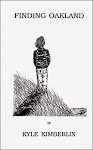
I just found out it’s Jack Kerouac’s birthday. In honor of which, the title poem from my collection, Finding Oakland. I had been reading On The Road – and evidently Crime & Punishment too – and was inspired. I still can’t read the last paragraph of On The Road without being moved, sometimes to the verge of tears. The man had a way with words.
The epigraph was used with permission of Stella Kerouac. Really. It’s good to get permission and not just take.

FINDING OAKLAND

            “because here we were dealing with the
            pit and prune juice of poor beat life itself
            in the god awful streets of man.”
                                                            Kerouac

In my heart, I have come back to
San Francisco, which sprang up
on the edge like a condemned man’s
last meal, where patience and action
are futile. I have come to kneel
where only prayer is valid.

In the Steinhart Aquarium, my brother
longed to swim in the cool peace.
In a dream I saw him on the BART,
plunge beneath the bay, searching
for water. But he rose up,
finding Oakland. He stepped
from the train, saying “we are
like men who have lost their legs.”

 In a dream I saw him walking
south on Mission Street, turning
into an alley and a dark pawnshop.
Like poor Raskolnikov, the price
was just too high. The fog
lingered about the hills, anointing
the housetops, hanging from street lights.

Then Jesus rose up through the steam
in the street, parting the traffic,
leveling light on everything.
Dragging the curtain torn in two.
An army of angels marched
down from Bolinas,
swinging the broken chains.

Watch The Sky For Me

Artist suspends real clouds in the middle of the room.

Follow that link to a page about an artist who creates real clouds indoors, for a moment, and photographs them. It's interesting. And here's an old poem.

CLOUD

We speak of life as an oboe
speaks, in Summer colors
stirring the orchards
playing the windchimes by the door.

You put the telephone down
and your voice hangs
a little cloud of new rain
over the cold and restless sea.
I cannot hope to disconnect.

How can a man admit he loves
so well, so hopelessly
these clouds that only turn
maybe hover
do not descend, never touch.

Now birds are rising in the dial tone
with a motion as still and breathless
as the respirations of a dying seal.

A squadron of great brown pelicans
is lifted from the harbor
to investigate the coming night.

If they will watch the sky for me
maybe I can sleep.

Kyle Kimberlin
from Finding Oakland