Here’s a joyous little video about a letter from Kurt Vonnegut to a group of high school students.
Yes. He was wise, because art is about the soul.
Here’s a joyous little video about a letter from Kurt Vonnegut to a group of high school students.
Yes. He was wise, because art is about the soul.
However your world is viewed, it must be your own … Only through a vigorous exactitude of presentation can the essential strangeness of life be conveyed … You’ll never be able to write a novel as long as you have the illusion that … the world you know is too dull and commonplace.
– John Braine
Writing a Novel (1974)
“Writing is not a career, it’s a disease. It’s something that you’re going to be doing whether you’re lucky enough to be paid for it or not. So if you have that disease–and you know if you do–if you have that disease, you don’t have to listen to people who tell you no.”*
– Dara Horn
It’s a strange sort of disease. The only way to prevent it from hurting you is to embrace it, become complicit in its process, and let it do its worst. If you ignore it, deny it, or worse if you try to treat it, then you suffer.
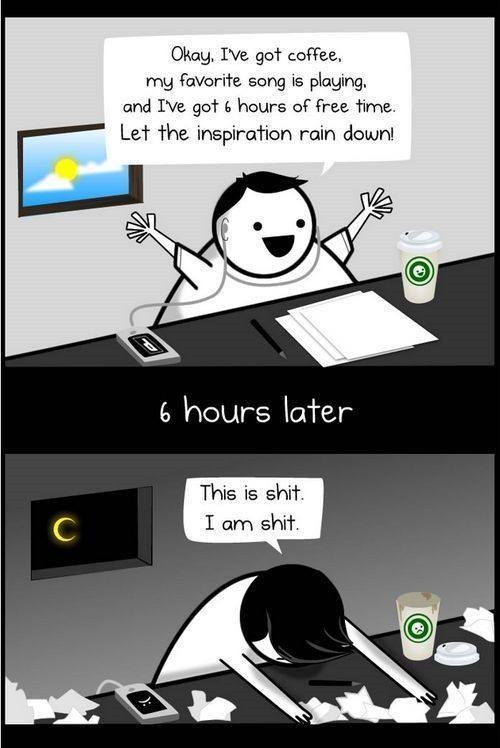
I haven’t been writing much lately and it doesn’t feel good. It’s because of the holidays, and short days full of busyness and long nights full of sleepiness, and because it feels like Inspiration is keeping her distance. I know she’s out there, crouching in the scrub brush on the bluffs or leaning against a trunk among the avocado trees, watching me. I need her to come here, into the lights and warmth of my comfort zone, but she doesn’t care. Inspiration has all the time in the world and couldn’t care less if my time runs out before I write another word.
Figments of our imagination don’t work for us, we work for them. Inspiration shows up when we’re working. And if we don’t want to do the job, they’ll find somebody else.
Bummer, huh?
I have heard it from hundreds of writers and teachers, all of my adult life, and our college poetry professor also told us this: If you want to write, read a lot. And write every day.
Every day. Nobody ever says frequently, or almost every day. They always say every day. So here’s my one and only New Years resolution: Every day, read, write, pray. I believe if I can do this, I’ll be happier and clearer-headed. And other things I ought to accomplish will more readily fall into place.
If you have something that works for you, or that you plan to try, please leave a comment.
Happy New Year!
* I heard Dara Horn say this in the Writers on Writing podcast from KUCI. Here’s a shortlink: http://goo.gl/bsGfP1
… On writing into the unconscious.
“I do not so much write a book as sit up with it, as with a dying friend. During visiting hours, I enter its room with dread and sympathy for its many disorders. I hold its hand and hope it will get better.” – Annie Dillard*
I chuckled effetely when I read this. I know about those visits, those bleak hours in the dim facility. You have to trudge far down the Formica-crusted hall, under flickering fluorescent, to Room 404: cohesion not found, please verify your path.
Get it? … Now that’s a little bit funny, right there.
Some of us write, not just to tell a story that we know and can tell, but to explore the unconscious, to give names and form to obscure emotions, to say the unsayable.
It’s not easy because it’s not fantasy, not entirely. We write ourselves so much, you know? And when the ink flows or the keys clack, we don’t always like what we find.
What can I tell you? Nobody confronts the pit and prune juice of his soul – and takes good notes – while watching puppies in a sunny park. It’s a night shift job, no way around it. So I should quote Cormac McCarthy, from The Crossing, because it happens to be the book on my desk right now.
It had ceased raining in the night and he walked out on the road and called for the dog. He called and called. Standing in that inexplicable darkness. Where there was no sound anywhere save only the wind. After a while he sat in the road. He took off his hat and placed it on the tarmac before him and he bowed his head and held his face in his hands and wept. He sat there for a long time and after a while the east did gray and after a while the right and godmade sun did rise, once again, for all and without distinction.
Keep the faith.
*Annie Dillard, The Writing Life (1989); Props to Poets & Writers .
“The very worst thing for an actor is to get caught acting, so the other trick is to know all of that intellectually, and then let it all go so it happens emotionally, naturally.”
– Wil Wheatonhttps://wilwheaton.net/2013/11/in-which-i-remember-to-keep-it-simple/
Right. And the very worst thing for a writer is to get caught writing. …No, the worst thing is to get caught not writing. But it’s still a valid concept. Art isn’t showing off. It’s not, “Wow, look at this ornate paragraph. Watch me pull a rabbit out of a hat!”
I seriously need to remember this. Here’s a poem by William Stafford that teaches it well.
http://www.poemhunter.com/poem/notice-what-this-poem-is-not-doing/
Get through a draft as quickly as possible. Hard to know the shape of the thing until you have a draft. Literally, when I wrote the last page of my first draft of Lincoln’s Melancholy I thought, Oh, shit, now I get the shape of this. But I had wasted years, literally years, writing and re-writing the first third to first half. The old writer’s rule applies: Have the courage to write badly.
– Joshua Wolf Shenk
It’s true and I have battled with other people over it many times. Imagine what you have to write is a business letter. That’s easier to write than poetry or fiction, right? Not necessarily; not if you get in your own way.
Is it going to be five sentences in one paragraph or twenty sentences in five paragraphs? You don’t know until you get something on the page. And the last thing you want to do is stop at the end of the first sentence and start correcting stuff. Just keep going, get it all out there, everything you need to say. Then go back and start fixing.
Otherwise, what you have is one slightly improved sentence and some unknown number that aren’t written at all. But the first sentence isn’t good yet, because you were using most of your brain to try to remember everything else you were going to write, and all of that unwritten stuff is rapidly fading into oblivion.
At least that’s how it is for me. My brain is good at one task at a time. It’s not good at editing while I’m trying to write.
OK, that’s a good first draft blog post. And it’s going to live or die that way because essentially what I’ve done is restate and paraphrase what Shenk said. Oh well.
I was clearing a few things out of a desk drawer and found a yellow sticky note with this phrase written on it:
“Intangible things are the writer’s business.”
I Googled it but I can’t find the source of this quote. It used to be the tagline of this blog, Metaphor, and now Google only points back here. (I switched to the quotation from Keats, above, in April 2010.)
I don’t think I made it up. It’s too brilliantly succinct to be me. I believe it though. We are surrounded by a cloud of the unknowable, unnamable, unspeakable and formless. The artist’s job is to give its particulars form and name, color and voice. The rare willingness and arguable ability to do so is the reason why we creative types get the big money.
Probably the first intangible, nebulous thing that comes to mind is my identity. I don’t mean the identity that a hacker can steal and use to buy stuff. I mean my self image. Who am I? Am I a good man or a self-centered jerk? Can questions of identity be that simple?
I remember studying the pathos of self image in college psych classes. I hope it’s not too wrong to say that your self image is who you believe you are, right or wrong. It’s what gets offended and bruised when someone misjudges you. And if you suddenly discover that the image of yourself that you’ve believed for a long time has been wrong, well that shit is really going to hurt.
Vanitas vanitatum et omnia vanitas.
If my sense of myself is intangible, isn’t my sense of belonging, of community, even more so? Can we expect our images of self to fit together like Legos? And then how is it even possible to dream, to have dreams, if we know so little about who we are?
“If you want a certain thing, you must first be a certain person. Once you are that certain person, obtaining that certain thing will no longer be a concern of yours.”
~ Zen proverb
I don’t know who I am, except that I go through most days with a vague sense of disappointment and a wariness against pride. I am, as Douglas Adams said of planet Earth, “Mostly Harmless.” I place a high value on Albert Schweitzer’s “Gentle hands and kindly words,” and love the first sentence of the anonymous 19th century Russian book The Way of a Pilgrim:
I am by the Grace of God a Christian man, by my acts a great sinner.
I can tell you more about my fears than about my dreams and desires. I know what and whom I love, that I have loved and been loved, that I am loved for today. But I’m not sure what I want, except that I’m sure I will always want love in my life. No one wants to be lonely.
At this point, you might want to listen to James Taylor sing Don’t Let Me Be Lonely Tonight, just because, you know, I rock at blogging.

If I don’t know myself, I certainly don’t know you. I’m still struggling to understand Kyle and everyone I’ve ever known. William Stafford said it best:
If you don’t know the kind of person I am
and I don’t know the kind of person you are
a pattern that others made may prevail in the world
and following the wrong god home we may miss our star.
Do you know for sure who you are? Is that a question you like to explore? I imagine you do. Such intangible things are common among us, being tribal creatures. Perhaps the world’s remaining elephants would nod in agreement and commiserate.
I’ve quoted this passage from Stegner’s “All the Little Live Things” before.
“I am concerned with gloomier matters: the condition of being flesh, susceptible to pain, infected with consciousness and the consciousness of consciousness, doomed to death and the awareness of death. My life stains the air around me. I am a tea bag left too long in the cup, and my steepings grow darker and bitterer.”
The writer’s job, then, is to walk the common thoroughfare, observe the suffering therein, and take a few notes; to reach out now and then and touch the hand of a fellow pilgrim on the way to infinity. Not a bad gig, right?
The problem, fellow pilgrim, is the fog, isn’t it? The blinding, low-down tule fog of the mind. It obscures everything: the road ahead and behind, the ditches by the side of the road, the trees and hills, the reason why your character can’t sleep, never finished building his boat, or became a long haul trucker.
I don’t know about you, but I write to find my way through that fog. This effort to see, to understand, to try to share the shapes forming in the thickly settled gray, is the path of all poetry. Poets are explorers of the intangible.
I remember one early morning in 1985, coming down the Sacramento Valley at Christmas. The fog was so thick, I had to open my door and look down beside me to see the line painted on the road. I survived.
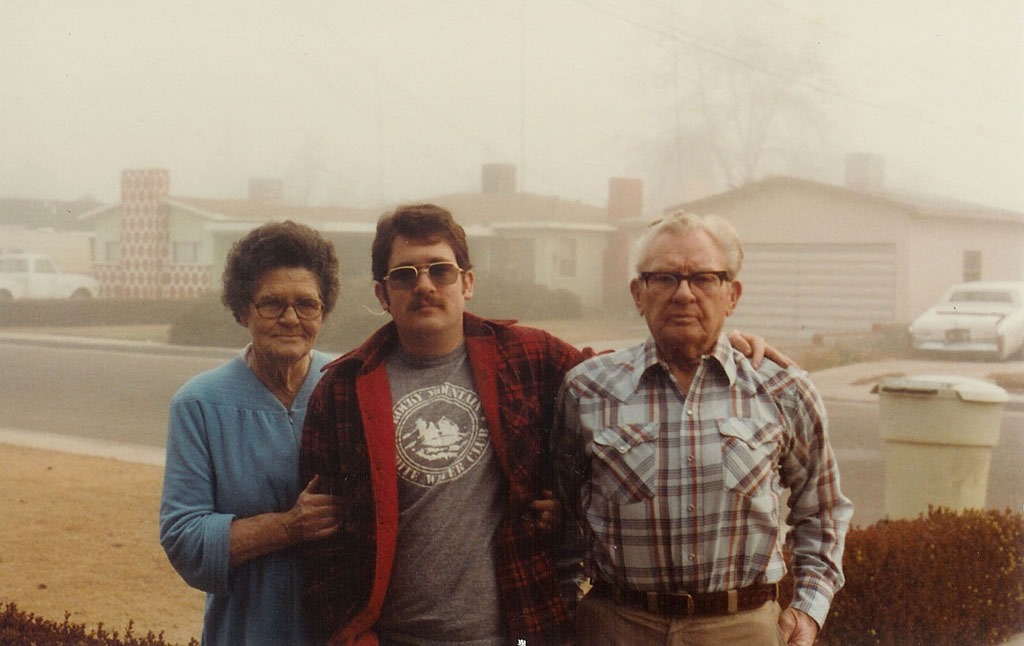
Here’s a photo of me with my grandparents, taken in 1983. The fog in the background was lifting and I was eager to get on the road, back to college, and on with my exciting and promising life. I just had no idea how long the fog would stay on the ground.
“Keep on writing, no matter what! That’s the most important thing. As long as you have a job on hand that absorbs all your mental energy, you haven’t much worry to spare over other things. It serves as a suit of armor.”
– Eugene O’Neill
Substitute ‘damn’ every time you’re inclined to write ‘very;’ your editor will delete it and the writing will be just as it should be.
– Mark Twain
If you have any young friends who aspire to become writers, the second greatest favor you can do them is to present them with copies of The Elements of Style. The first greatest, of course, is to shoot them now, while they’re happy.
– Dorothy Parker
“Books are in no hurry. An act of creation is in no hurry; it reads us, it privileges us infinitely.”
 Metaphor