Category Archives: pets
the fur flies
I was standing in line at my yokel Starbucks the other day. It was busier than usual – the weekend – and they were getting orders from people in line, to stay ahead of the rush. I had already ordered my tall drip, simple house coffee guy that I am. I heard the barrista take an order from the guy behind me, then ask, “service dog, sir?”
“Excuse me?” the guy answered.
“Is this a service dog, sir? Because otherwise we really don’t allow …”
“Yeah, the dog is serving me.”
I glanced back and saw the guy had a little dog on a leash, in the coffeehouse. Looked like a poodle mix to me. Which is illegal in California; you can’t take a dog in a place that serves food, unless it is a service dog, such as a guide dog for a blind person. And if that little white fuzzball was a service dog, I’m a giraffe in a tutu. Still, I kind of admired the doofus for keeping his dog with him, not tying it up outside or something. Pets are family. And I see no rational reason not to allow such a dog in a coffeehouse.
I predict things may change, that we’ll see more and more pet-friendly businesses. I hope so. Here’s a story from today’s paper, about a pets-only airline. No joke.
“The pet-only airline launched its inaugural flights last week to much fanfare among animal lovers who share Wiesel’s distaste for sending a cherished pet into the underbelly of a jetliner.” [Los Angeles Times]
playtime
OK, so I was trolling through the tubes, checking out cute doggie videos. Found a good one, 2 dogs playing without humans interfering.
Tribute
everywhere you look
there are reminders of her. This place is entirely steeped in her beautiful, joyful presence. In each room, places to rest or to play. Her toys are here and there, her beloved bed, and her stroller is parked by the front door. The stillness of that alone is terrible; I will spare you more than to imagine it empty.
Here, on a much better day …
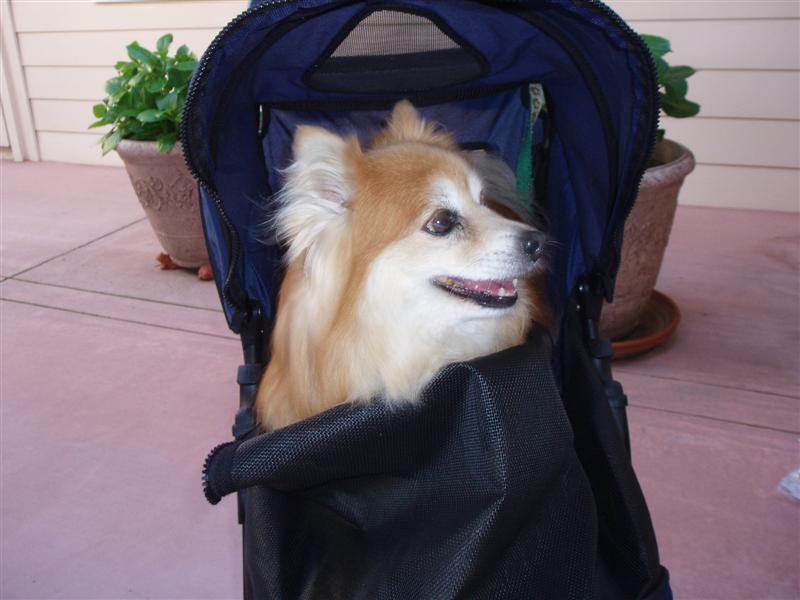
Happy used her stroller often in the past year – and daily in the last month – because she was getting on in years. And there was heart trouble, kidney disease, an ulcer. Still, she was a dog who lived to ramble, to amble, to run and run. And to ride! Oh yes.

Hard to believe those two photos were taken over a year apart, and that in the second she was already in treatment for so many things. Still smiling, still Happy.
I know, I take too many pictures with the silly phone; only 1.3 megapixels and the exposure usually sucks. Here are a bunch of better ones.
I guess those who read this blog but don’t follow the blogroll link to Happy’s Trials may not know what’s been going on. That’s our dog’s blog, where she posted her final entry Wednesday 7/8, just hours before her gentle veterinarian came to send her ahead to the Rainbow Bridge.
Happy was diagnosed with “renal insufficiency,” meaning early kidney failure, in April. She got a few fluid treatments and seemed to do better until late May. Then we thought she had a stroke, because she was staggering and stumbling. That turned out to be a thyroid imbalance and she rallied again, until an ulcer was diagnosed in early June. Then followed a course of acupuncture, herbs, etc., with a holistic veterinarian.
Throughout June, Happy had ups and downs, challenges with energy and appetite, longer naps … but there were good days, you know? Here’s a little video of Happy running through the yard and around the deck, on June 20.
We thought she was doing pretty well until this last week, around the 4th of July. The ulcer seemed to have healed, her heart was beating strong. But she got more tired, lethargic, weak. So on Tuesday she went for lab work and x-rays. I prayed that it was just a little something with her heart, because in the past we’ve been able to adjust heart meds and make her feel good. But the news was very bad. Complete kidney failure. Nothing could be done. The vet said, “you wouldn’t be wrong to let her go,” and “she’s suffering.”
Well, when you hear that, you have to do what you have to do, right? I mean the difficult and devastating thing, the brave and loving, almost impossible thing.
Now it’s Friday and she’s been gone for two days, and the house has come unstuck from earth. It seems to rise and fall, adrift on a sea of her absence. The silence, without her barking at birds or for cookies, is infinite.
This is not a tribute for my friend; I’ll post one to my Web site when the time is ripe. Because with this sorrow there is a life so much to celebrate, and gratitude for a wonderful, enduring gift. Just thought you’d want to know the strange weather, now the wind has turned.
If you have a fuzzy little friend, remember: time flees.
She Loved
Lord, at the ending of my life
the sun which You have made
will shine. The road will rise to
meet me, and so Thy Kingdom
come. Please send this dog to
lead me, Lord, who stood
beside me long on windy
bluffs to guard against despair.
She loved to walk and in her years
she learned to let the binding
leash hang loose. And since she
always barked for love, would in
Thy songful Heaven sing so well.
© 2000, 2005 by Kyle Kimberlin
on happiness
Not many updates on Metaphor lately. I’ve been preoccupied.
I’ve posted today at Happy’s Trials.
Happy might have an ulcer
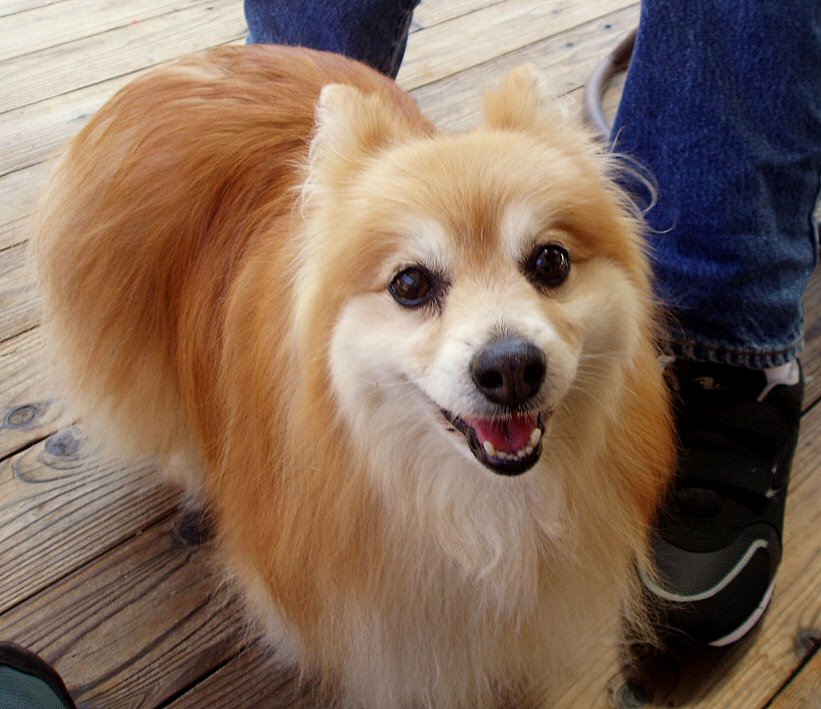
She’s not feeling well at all today. We’re concerned.
Happy’s blog
Happy has updated her blog today, with new photos and videos.
angry?
Are you feeling a little put out, peeved, annoyed? Feeling the need to protect your warm fuzzy little sanctum, home sweet home? This doggie can relate.
happy news
Our little Pomeranian Happy has been having some health problems the past few days. You can read about it on her blog. There are also some new videos and photos of her there.
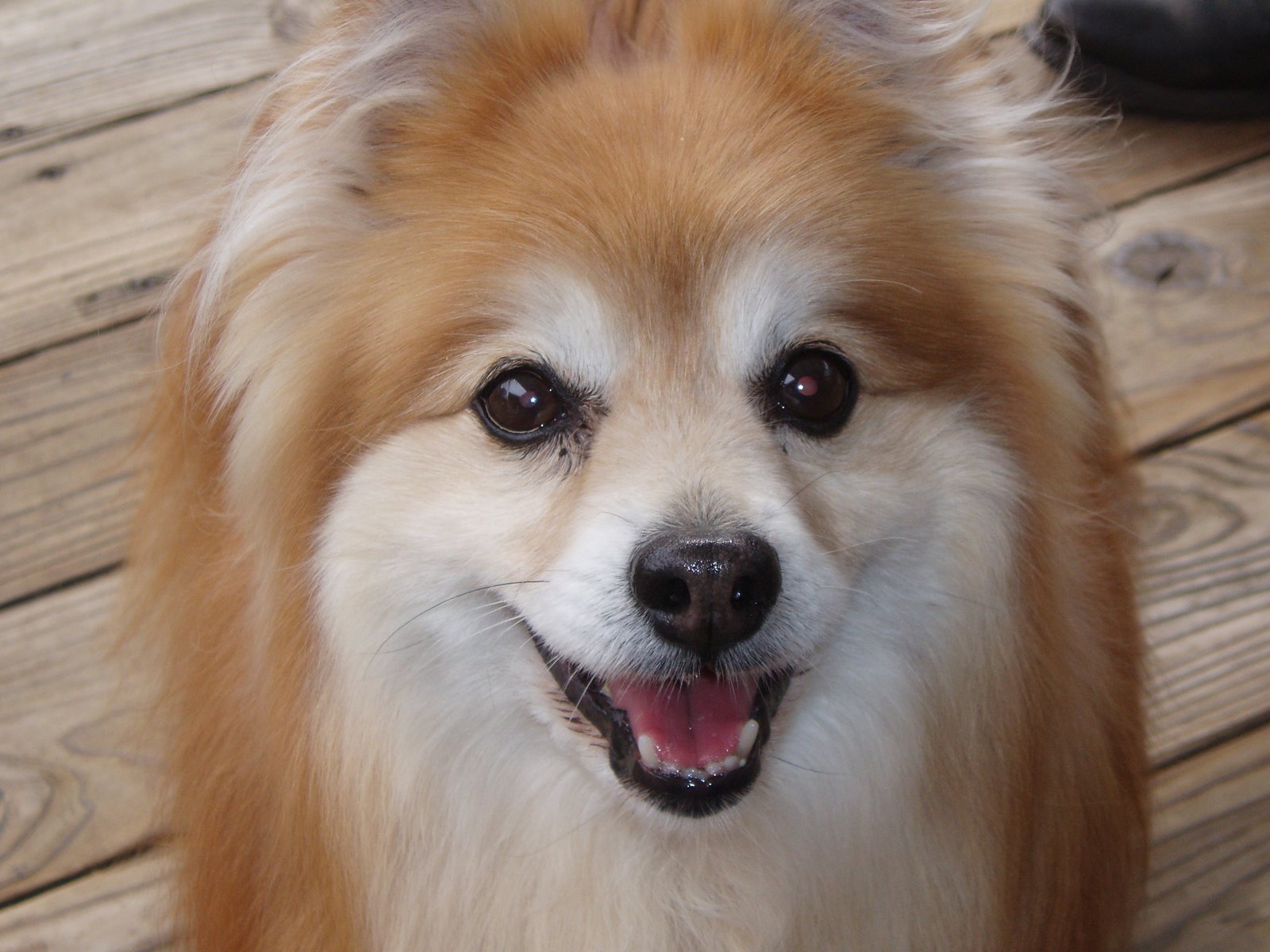
don’t shoots me
Ize only da piano player.
attending mystery
I was just going to post a vignette for you to read. I’m polishing it up to get it ready to submit for publication. I think it’s about ready to go. It’s got a clean shirt on, and a good hat to keep the rain of its little face. It’s awfully small – only two pages – to go out alone in the bold and verbose world, but I’ve done my best by it. All the rewriting set me to ruminating a bit, along these lines:
On a recent morning, drinking my coffee and listening to the critical whispers of my carpets, I read a very nice – meaning thoughtful and well-crafted – article in the LA Times about death. Rather, about a man who will soon see the end of his life, and whose lifelong career in thantology and suicide prevention has made him a unique subject for consideration in the matter of impending death.
I should clarify that if the perspective of this article is to be entertained, it is not this man who will see the end of his life. One’s death is experienced by others.
Here’s an excerpt from Waiting for death, alone and unafraid, Los Angeles Times:
“In death, things become mere things — the statue of Venus in the backyard, the gyotaku print in the kitchen, the Melville-inspired shadow boxes — no longer animated by memory, the story of their provenance. It is as if their atoms loosen and dissipate.
The meaning of death is loss and sadness and inevitability. On the wall above the bed, he has hung a print by Breughel that covers a crack in the plaster. Here an army of skeletons wages war against humanity, and compared to the Chagall overhead, it’s a bleak and macabre picture of the final hour that without angels or signs of salvation is unremittingly godless.”
Here’s a paradox: if death is experienced by others, and things become mere things, how is it that the things – mementos, memories – which are the legacy of our loved ones become so abjectly, enormously dear? I think the writer of that article has it backwards. Things are things until they’re all we have left. I have things that came to me from hands still warm and hands now beyond cold, and I have enough compassion for myself and those who gave them to me to know better than to call them mere.
The poet Rainer Maria Rilke wrote, “I live my life in widening circles that reach out across the world. I may not complete this last one but I give myself to it.”
What is such a widening circle? To me, it is a consciousness of compassion, and that consciousness is the function of poetry; in other words, the exploration of authentic human experience. We are all in this together.
There is a subset of authentic and universal human experience which we can call true for everyone, and which really make our emotions ring. These are the primary colors of our daily lives, the things which we carry everywhere, everyday, and which define us. They are love stripped of romance, fear free of titillation, and death devoid of pride. Also, the small moments and rare intangible things which offer consolation.
The problem for a poet who sits down with a notebook and a pen and hopes to dig in to truth is that these things are just so intangible. But then, intangible things are the poet’s brush and paint. We have to live with that. We have to stare death in the face because it is in the great commonality, and keep it right here – right here – in front of our dusty spectacles. And not blink. See the metaphor …. be the metaphor.
Does it help to be a little crazy?
Phenomenal nature shadows him wherever he goes. Clouds in the staring sky transmit to one another, by means of slow signs, incredibly detailed information regarding him. His inmost thoughts are discussed at nightfall, in manual alphabet, by darkly gesticulating trees. Pebbles or stains or sun flecks form patterns representing in some awful way messages which he must intercept. Everything is a cipher and of everything he is the theme. Some of the spies are detached observers, such are glass surfaces and still pools; others, such as coats in store windows, are prejudiced witnesses, lynchers at heart; others again (running water, storms) are hysterical to the point of insanity, have a distorted opinion of him and grotesquely misinterpret his actions. He must be always on his guard and devote every minute and module of life to the decoding of the undulation of things. The very air he exhales is indexed and filed away. [Nabokov, Signs and Symbols]
There is a line in the book A Separate Reality by Carlos Casteneda which has stuck with me since I read the book in 1986, though I’m not going to spend a chunk of my finitude trying to find it and be exact: “I have my aly, the little smoke has shown me my death with great clarity.” And The Chink from Robbins’ Cowgirls says “Ha ha ho ho and hee hee.” I say it’s a mystery.
OK, maybe I’m getting a little carried away. My point is that poetry is for saying the things that are unsayable, for naming the truth the dog would tell you if he could talk. The poet William Stafford wrote this about that:
Your good dogs, some things that they hear
they don’t really want you to know —
it’s too grim or ethereal.
they don’t really want you to know —
it’s too grim or ethereal.
And sometimes when they look in the fire
they see time going on and someone alone,
but they don’t say anything.
Mark Twain wrote, “The dreamer’s valuation of a thing lost–not another man’s–is the only standard to measure it by, and his grief for it makes it large and great and fine, and is worthy of our reverence in all cases.” And I say Amen, and if anything depends on red wheel barrows and white chickens, then everything depends on how my grandfather watered his tomatoes, how grandma smoothed a quilt on the bed.
We are attending a mystery, a continuous and ineffable transubstantiation of Being, no less than the passage of galaxies through needles’ eyes, no greater than an hour pulling weeds in the front yard by the gate. Perhaps exactly the same size as a dog’s collar or a homemade pie. And how can we sit down and try to write it? Because of something John Gardner said, “The organized and intelligent fictional dream that will eventually fill the reader’s mind begins as a largely mysterious dream in the writer’s mind.”
That is compassion, and that’s the job of the poet, isn’t it? We aim to write something beyond us, something that can’t be contained by the margins of the page. We fail. Words fail. We keep writing. And in the end, what remains is a final kindness. Which brings me to the end of my post.
 Metaphor