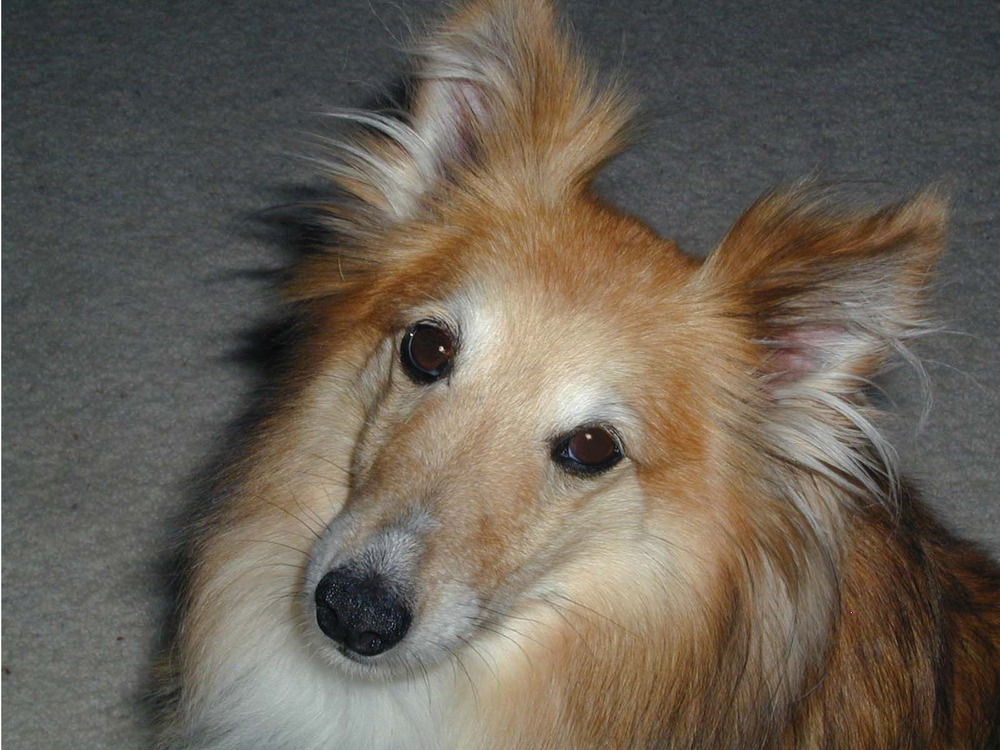
Lying To The Dog

I used to have a little motto in my writing practice: Never lie to the dog. See, I used to read my poems out loud to my dog. We had a deal that what I read would always be the truth, even if I made it up. I got to thinking about that one time, after she was gone, and I wrote this little something out of that general idea.

It is a very short “story” or vignette, not based on anything in my life at all, except the constant prescience of dogs. I let it age like cheese for a while, then brought it out and prepared it for you.

“Memory believes before knowing remembers. Believes longer than recollects, longer than knowing even wonders.”
~ Faulkner, Light in August

it stands alone

"Had I not gotten up to get the cheese, I would probably be dead."

– Gerri Guardipee

This Seattle lady narrowly escape death by going to her kitchen for some cheese. Seconds later, a car crashed through her living room.

too many words

I received an e-mail from a loved one, asking me to help open a word processing file which she had received from a colleague. It was a docx file, which is what Microsoft (MS) Word creates in Office 2007. If you have any previous version of Word, you use the doc file format. 
If you use Microsoft Office and Word, and you’re tired of spending money on them, this long post will be interesting. Otherwise, surf on, MacDuff!… This post comes with a serious Geek Alert.

The Situation

Over the years, as I’ve gotten newer computers, I have elected not to purchase the new MS Office, which came installed on them as a trial version. I already had Office 2003, and I think it’s just great. So I use Office 2003 and I have a special program from Microsoft that converts docx into doc, if necessary.
Note: Word 2007 can easily make a doc file instead of its default docx. Or you can change the default to always make doc instead, and everyone could use your documents, and you wouldn’t have to worry.
Docx is really only needed by people who create pretty advanced XML compliant documents. XML meets broader worldwide standards, that have nothing to do with most of us. Microsoft was under pressure to meet these global standards, which is why they stopped using the doc format in 2007. They needed a Word format that’s compatible with XML.
Ironically, most modern computer systems can use XML, even if they don’t have MS Office and can’t use Word’s doc files. The program that has the most trouble with XML and docx is Word 2003. This is because Microsoft made doc so that you must have MS Office to use it, and you must buy MS Office from Microsoft. This is called proprietary software. 
I suspect Microsoft could have issued a service pack update to Office 2003, so it could open and create docx. Instead, it came out with Word 2007, made tons of money, and made a little converter called a compatibility pack. This free download lets Word 2003 open docx, but not create it.   
Anyway, I have the converter, so I was able to open the docx file my loved one received, make a PDF file, and send it back. Why PDF? Because that’s how you share a finished document.  
Word processor is to documents as food processor is to food. It’s not finished yet. Use a free PDF converter and send a PDF. Sending someone a Word file – unless you want them to work on it with Word – is like walking into a party with a big bowl of flour, sugar and eggs and saying, “Look! I made a cake!”
In a perfect world, there would be free software that would create both doc and docx, and whatever other format you might need, even PDF, and everyone would be happy. Does that perfect world exist now? … Yes! … But …

Free Software for All? This isn’t it …


On Thursday I received an e-mail from PC World magazine, with an article about how wonderful the new Microsoft Office 2010 is going to be, when it goes on sale in June. Let me show you how wonderful. Follow the arrows.

office2010_price.jpg

I have tried Office 2010, in the free Beta (test) version that Microsoft offered. It’s very cool, but it’s not necessary. The vast majority of people who need to create, share, and publish documents don’t need all the fancy new features. Just like we don’t need phones that run 100,000 different software applications.
Now don’t get me wrong, Microsoft is an excellent company making great products. But 500 Clams – more than half the cost of my very nice desktop computer – is just absurd. $500 software for an $800 computer is like a $50 bulb for an $80 lamp. And Microsoft’s proprietary closed system has just become a burden on us all. 
That $499.99 price is no doubt for the Professional version. You can get lesser versions like Home and Student for about $150, but it doesn’t come with MS Publisher, which I need. That’s another $150, so we’re back up to $300. And then you have to worry about how many computers the license is good for. Because MS Office is protected by licenses and lawyers, and long complicated product codes that have to match or you can’t re-install it. 
Here’s a scary thing. Office 2003 has been my tool of choice for 7 years and has served me well. I have my trusty Office 2003 Professional installation disc in my drawer. If I lose that, you’d think that I could replace it pretty cheap. It’s the old product. Nope, it’s still $289 – $489 through Amazon.

Why are we doing this?

Here’s a weird thought: Bill Gates has enough money. Do you?
I don’t, and I’m ready to stop. I say No. No more. Basta. I think it’s time to ease off the Microsoft hamster wheel. I paid for Windows with the machine. But I want free Office software without stealing it. Because you know that if you spend $300 – $500 for Office 2010, it will be obsolete before you know it. And the cycle never ends.

Happily, There Is A Solution

About a year ago, I got a new Office software suite. I didn’t pay for it, I didn’t steal it, and it’s been living nicely on my computers right along with MS Office 2003. I’ve been using OpenOffice.org for many of my writing projects.
OpenOffice is an office suite like Microsoft Office. It has a word processor like Word called OpenOffice Writer, a spreadsheet like Excel, a presentation program like Powerpoint, a program for scientific formula and equations which I’ve never opened, and a database program like Access. It even has a drawing program, like … MS Office doesn’t have.
OpenOffice Writer is what Word 2003 would be now, if Microsoft had kept making it better, and letting customers download improvements. Writer is fully capable of opening or creating Word’s doc and docx file types. So I can make whatever other people need. And its default odt (open document text) format is possibly a superior XML file to docx. Some people say so. 
So Writer makes Word files if I need to make one for someone, and it creates PDF files with the click of a single button
This isn’t a secret tech writer thing. OpenOffice has been downloaded over 100,000,000 times. That’s one hundred million. People all over the world use OpenOffice and other alternatives to Microsoft Office. Big companies, even governments, use it too.
Again, it’s free. Gratis, which means the same thing. And every time there’s a new version released, or updates, you get them free too. So it’s always new.

Perhaps just as important as being free like free lunch, OpenOffice is free like free speech. It’s free to download and use without a license. Take as many as you need. Plus, the underlying structure – the programming called Source Code – is open for software people to download and tweak and experiment, and improve. It’s sponsored by Oracle, and several other companies, who have a mission of open sharing and collaboration. I think ethically and socially, that’s very cool.

I like Writer very much. There are a few little things I like better about Word because I’m used to them, but mostly Writer’s great. So I’m making a gradual transition, learning as I go. I have open projects in both Word and Writer, and existing documents that I don’t want to convert to Writer just yet, though I could if I wanted to. I have more to learn about Writer first.

I’ve been using Word 2003 for all these years, at home and on the job, and I’ve still got a lot to learn about that. I’ll keep using it too, and I’ll be careful not to lose that old disc.

So if you think you paid Microsoft enough for the Windows license that came with your computer, and you’re tired of playing monopoly with Bill Gates, you can get OpenOffice too. It’s an easy download and install. 
possibles

I wrote this sentence today:

John rode in the back, where he had made himself a place among our possibles.

The first run through of the sentence read:

John rode in the back, where he had made himself a place among our belongings.

Of course, spellcheck didn’t recognize the word possibles. (Spellcheck doesn’t recognize the word spellcheck, either.) Neither does my Websters or any online dictionary. Possibles is an arcane word. I say that because it’s one of those words still known to a few of us who’ve listened carefully to the idioms of people who used words like icebox. Otherwise it is lost, or at least fast fading from the lexicon.

It’s too bad. Possibles is a great word, flexible but meaningful. I suppose you could substitute the word essentials, but that’s not quite the same.

Possibles once meant one of two things:

A person’s possessions which made it possible to live and persevere. Your knife, gun, ammo, food, etc.

Those possessions which it was possible to take or carry about. The stuff that would fit on your covered wagon. Which implies a need to prioritize one’s possibles.

In one sense, one’s possibles were his survival kit. Hunters and frontiersmen had things called possibles bags, which contained their gunpowder, rifle shot, etc., which made shooting game possible.  You can still find “possibles bags” or “possibles pouches” on the Internet, some made in old-fashioned styles.

Here’s an example of a modern possibles bag, with the blogger’s explanation of what he’s putting in it.
In the movie Jeremiah Johnson, the title character – played by Robert Redford – meets up with a pilgrim name Del Gue, who has been attacked by Blackfeet Indians. They buried him up to his neck and stole his horse, his rifle and his pelts. Johnson agrees to help him get them back.

Having found the enemy’s camp, they discuss whether to attack at once or wait until the men are asleep. Del Gue wants his stolen things, and he also wants revenge. Johnson insists on waiting, and avoiding a fight. “I have no truck with them Blackfeet, I plan to be here a long time.”

After dark, he says, “Should be no trouble to slip in there and then get your possibles.”

That’s a correct usage of the word, I think. It’s that which makes your living possible, your essential stuff. And what’s better than to have such a useful word as that?


the high cost of ash

I have a confusion.

I keep reading in the news that the effects of the volcanic eruption in Iceland led to a massive financial loss for the airlines. For example, in this morning's Los Angeles Times:

Critics accused authorities of having bungled their response to the airborne grit by imposing an unnecessary near-total flight ban that cost the airline industry $1.7 billion. [Link]

I understand that flights had to be canceled and people were left stranded. But what did they do, decide to give up and buy real estate where they were stranded? I mean, aren't they eventually – as soon as possible – going to buy another ticket and go to where they won't be stranded?

If people already live in the area from which they intended to begin travel, and were stuck there – at home – they weren't stranded. They were unable to travel. And that's not what the news has been reporting. 

Unless the stranded people decided to live where they're stuck now (screw it, Honey, let's just buy a house here) the airlines have postponed sales, not lost them, right?


that’s memory?

If you asked me what my novel is going to be about, I’d probably give you a synopsis of the plot. But if you responded, quite rightly, “No, that’s what seems to happen. What’s it really about?” I’d say it’s about memory.

For years, I’ve been mulling over the idea of what memory is and how we hold it, and what there is in our lives and families that is common to the experience of memory. It’s a little like trying to get a grip on a very annoyed trout in a bucket of baby oil.

Now comes the novelist Tim O’Brien, author of The Things They Carried, trying to get his own fists on the fish. In this brief and thoughtful video, he does it quite eloquently.

the rain rising up

I was leafing through an old notebook a few nights ago and found a snippet of poetry I wrote in a workshop in 1995. This seemed like a good time to polish it up and see if it will shine. 

So I edited it, moving lines and stanzas a little, correcting a few lost phrases, changing the breaks, and adding the title.

It is in part a celebration of a moment, and in part a wish to turn back time.

The Rain Again

My dog has been out
in the rain again,
and comes in bringing
small gifts of mud
between her toes and water
from her back to her chest
and I am here another night
to see this, her smile.

What if the whole storm
was shifted into reverse?
The rain rising up into the clouds,
swelling, growing heavier
and turning hard out to sea.

I dry her with a towel,
smelling the rain in her coat.
I am here, she is tugging
on the towel,playing,
and I would not
sell this for anything.

Creative Commons License
The Rain Again by J. Kyle Kimberlin is licensed under a Creative Commons Attribution-Noncommercial-No Derivative Works 3.0 United States License.

raising arizona

Los Angeles Cardinal Roger Mahony lambasted legislation passed Monday by Arizona lawmakers that would crack down on illegal immigrants, likening it to "German Nazi and Russian Communist techniques" that compelled people to turn each other in.

"The Arizona legislature just passed the country's most retrogressive, mean-spirited, and useless anti-immigrant law," he wrote on his blog. "The tragedy of the law is its totally flawed reasoning: that immigrants come to our country to rob, plunder, and consume public resources. That is not only false, the premise is nonsense."

Los Angeles Times

I agree with the Cardinal, except in one way: the law isn't useless. It serves quite ably to create a climate of fear and dehumanization. It's unamerican and unchristian, which is why all Christians and their leaders like this one should speak out against it.

your moment of zen

"Eat food, not too much, mostly plants."

~ Michael Pollan

“Before enlightenment; chop wood, carry water. After enlightenment; chop wood, carry water.”

~ Zen proverb

"If you want a certain thing, you must first be a certain person. Once you are that certain person, obtaining that certain thing will no longer be a concern of yours."

~ Zen proverb

"Now I don't know but I been told, if the horse don't pull you got to carry the load."

~ The Grateful Dead

do you do or do you don’t?

That post title amuses me. It reminds me of a scene in the movie Oh Brother Where Art Thou: “Is you is or is you ain’t my constituents?”

I’ve been gradually reading through The Guardian’s Ten Rules For Writing Fiction:

“Get an accountant, abstain from sex and similes, cut, rewrite, then cut and rewrite again – if all else fails, pray. Inspired by Elmore Leonard’s 10 Rules of Writing, we asked authors for their personal dos and don’ts.”
Here’s a link.

It’s really fun stuff, and much of it is very helpful.

Do not place a photograph of your ­favourite author on your desk, especially if the author is one of the famous ones who committed suicide.

– Roddy Doyle (He’s British, he can spell favorite that way if he wants to.)

Having completed my taxes, I read these first and last rules by Hilary Mantel:

1. Are you serious about this? Then get an accountant. …

10. Be ready for anything. Each new story has different demands and may throw up
reasons to break these and all other rules. Except number one: you can’t give your soul
to literature if you’re thinking about income tax.

Oh, well, now she tells me. But it’s alright, since I’m not sure I buy the premise that I’m reasonably expected to give my soul to literature, or anything else on any given day.

I’m just a pilgrim and a stranger, passing through this worrisome land. 

Besides, I wasn’t thinking about income tax. If I had been thinking about it, it would have been done in February.

Here we find some sensible tips from Esther Freud:

2. A story needs rhythm. Read it aloud to yourself. If it doesn’t spin a bit of magic, it’s
missing something.

3. Editing is everything. Cut until you can cut no more. What is left often springs into
life.

4. Find your best time of the day for writing and write. Don’t let anything else interfere.
Afterwards it won’t matter to you that the kitchen is a mess.

5. Don’t wait for inspiration. Discipline is the key.

Good tips for process there. I do read aloud to myself. A habit picked up in writing poetry. I think good writing is a form of music; it shouldn’t be too shy to sing. 

I take editing pretty seriously; at least, I’m getting better at it. But the other 2 rules I’ve quoted there, at those I don’t do so well. Which brings me finally to the point.

What steps do you take to achieve what all the writing professors on the planet have agreed is the most important thing, keeping the writer’s ass in the writer’s chair?

I had a prof who used to write A – I – C in big letters across the chalkboard – “Ass In Chair!” Or maybe it was On chair, or Ass + Chair. It doesn’t matter. It really is something they tell you, though. Just keep at it, don’t get distracted, don’t give up. You can google it.

Neil Gaiman’s first 3 rules are

1. Write.

2. Put one word after another. Find the right word, put it down.

3. Finish what you’re writing. Whatever you have to do to finish it, finish it.

And Neil is no slouch. Prolific, he is. And he’s had some success for himself, especially in the past year. So one should pay heed, is my point.

I don’t take any special steps for keeping ass on chair. I make myself no promises. Dust in the wind, born on the vicissitudes of the unwinding day. … Perhaps I exaggerate. I have some self discipline, but no schedule.

One of the most strident rules I’ve heard over the years, “make time to do it every day,” gets thoroughly blown off around here. But it makes sense. A musician doesn’t skip a day of practice, right? Every day, that’s how you keep your chops.

So what do you do and what do you don’t? Do you set a schedule? Write in the morning? Unplug the phone? Unplug the Internet? Take a 12-gauge to the TV? Put your pet possum down for a nap? What works? 

The second most important writing rule is “Read!” We’ll cover that another time. For now, 2 more from Gaiman:

6. Fix it. Remember that, sooner or later, before it ever reaches perfection, you will have
to let it go and move on and start to write the next thing. Perfection is like chasing the
horizon. Keep moving.

8. The main rule of writing is that if you do it with enough assurance and confidence,
you’re allowed to do whatever you like. (That may be a rule for life as well as for
writing. But it’s definitely true for writing.) So write your story as it needs to be written.
Write it honestly, and tell it as best you can. I’m not sure that there are any other rules.
Not ones that matter.