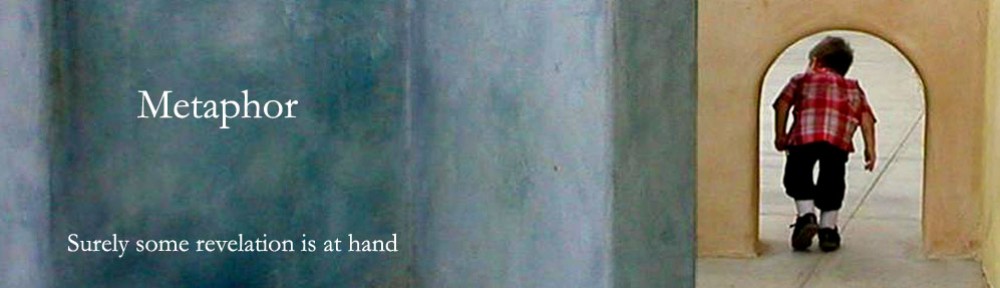
He will not stop to talk, but looks at the stones ahead of him, at the sky gone to dishwater in the late afternoon, and away at the boats where they move to their moorings for another night without rain, without wind. Everything is gentle. A great blue heron sails for home. A woman walks a massive dog.
Our man can’t worry for Rottweilers, or the train as it rises up and lunges from the darkened grove of cypress, and pounds away behind a hill. He has a fear for life itself, for all the cracking crystal bones of it. He holds it all together with his prayer.
He is alone now, except for you and me and the trees, and the last of the sun. A sliver of hot coal, fused to the sky beyond the islands and the sea. What is he doing? He has given up on all of this, time and place, despite the rose and saffron dying in the highest clouds, because the trees have gone to charcoal gray.
Arriving home, he climbs the stairs and looks out on the scene of water, trees and sky. The last of the train has faded now, and everything turns toward its end. All of which leaves him spent and drained, as though he needing emptying for night to come. He locks the door behind him, kicks off his shoes against the baseboard by the mat, and goes from room to room to light the lights.
Why does it have to be this way? He counts his footsteps up and down the hall, and puts a cup of coffee on to drip. He has a hundred books he ought to read, and concertos for the violin. If you asked the number of his clocks, he’d simply shrug and look away.
He does not believe in ghosts. But his grandpa comes leaning on crutches, half past the evening news, to check the locks and dim the lights. Grandma layers blankets on the beds. In every room a dog is keeping watch. He believes in memory. We see him, deeply breathing, draw it in.
He remembers the fog that would come before morning, and how at dawn the trees would be submerged. All the neighbors’ houses sunken, gone to God. By noon the sea would melt, give up her dead. He loved those mornings of scrambled eggs and Papa with his newspaper. Now he lies still and tries to sleep, and listens to the gently settling house.
The birds wake up at six o’clock; they’re cheeping in the myrtle hedge, but he has left the windows closed. It’s cold this time of year. He dreams of organizing shadows into words, and chasing them in panic through a book. At nine o’clock he eats two eggs, then shaves and drives to town.
He always signals turns, as if nothing changes course without a plan. Nothing veers away and winds up lost; not if he holds this tightly to the wheel. And watches how the light comes smoothly through the glass, not broken into facets like a world of quartz. God, such responsibility, to hold it when his hands are wet. When some people, even in their love for him, seem bent on destruction. They jostle, shove, and laugh at him or sometimes weep. So he whispers a prayer for more time, another chance, and a firm grip so that all of this will live.

Something About Mercy by J. Kyle Kimberlin is licensed under a Creative Commons Attribution-Noncommercial-No Derivative Works 3.0 United States License.
 Metaphor